The achievement, achieved by a team from the Department of Oceanography, will make it possible to study the captive reproduction of this strategic species for aquaculture and conservation.
Deep cod, (Dissostichus eleginoides) is one of the most emblematic and challenging species of the southern ocean. According to Sernapesca, it is a fish that lives along the entire national coast, between 50 and 3,800 meters below the surface, and its main destination markets are China, Singapore, South Korea and Mexico. However, the also known as mere has suffered overexploitation, even to be considered exhausted, so today it has global catch quotas to protect it.
In this context, a team from the Laboratory of Fish and Aquatic Pathology of the Department of Oceanography University of Concepción (UdeC) achieved a scientific milestone of global relevance: they managed to keep wild specimens alive and in good condition, in growing ponds installed in the Biobío region. This achievement opens the door to the development of plants where the captive breeding of deep cod can be studied, and future advances towards its cultivation can be undertaken.
The project, funded by the National Agency for Research and Development (ANID) through its FONDEF line, and with the support of Antarctic Salmons S.A. and Coastal Fisheries, contemplated the capture, transport and acclimatization of live fish from open sea fishing areas to the ponds located in Baletto.
“The operation, which lasted from August to December, faced extremely complex conditions: the presence of sea lions, sharks and orcas complicated the catching process and affected the increase in barotrauma, or damage caused by the change of pressure in the fish caught to 1,200 meters deep. Despite this challenge, the team managed to form a stable stock of specimens, including large individuals, that exceed 7 kg., range associated with the first gonadal maturity in this species”, explained the marine biologist Alberto Reyes, Team member.
After overcoming the critical period after capture, fish today show active eating behaviour, good physical condition and absence of recent mortality. “To count on these living specimens is a huge advance. There is no other institution in Chile and no other part of the world that keeps deep cod in captivity under these conditions“ ” said the Project Director, Marine Biologist and Doctor of Biological Sciences at the University of Concepción, Dr. Ariel Valenzuela Saldias.
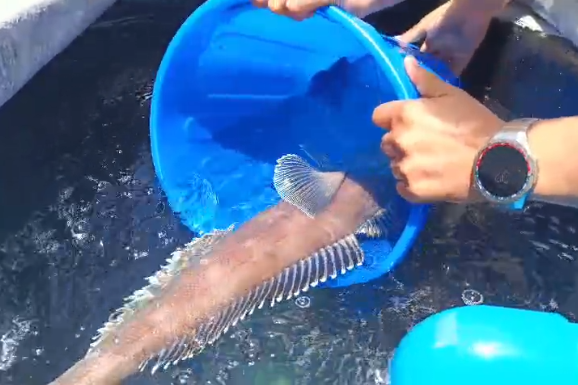
The researcher added that this group of fish is the basis for the first reproductive analyses (maturation) by ultrasound, including growth measurements, body condition, hormonal studies and blood sampling.
“In fact, This project also opens up the possibility of studying at the genetic level the expression of certain molecular markers of puberty activation, both in the brain and in gonads, what has not been observed in this species previously” indicated the Dr. Sebastian Escobar, academic at the Pontifical Catholic University of Chile (PUC).
Scientific and commercial value
Deep cod is a species of high economic and strategic value for Chile, but its biology, particularly its reproduction, remains a mystery, due to its life in cold and deep waters, explained Dr. Ciro Oyarzun. “Knowing the larval and growing processes in captivity is key both for future cultivation plans and for conservation measures,” he said.
“Advanced cultivation in captivity would not only open up new scientific opportunities, but also evaluate, in the long term, sustainable alternatives to diversify national aquaculture, generate applied knowledge and contribute to the responsible management of this fishery, emblematic of the southern end of the planet,” said Dr. Ariel Valenzuela.
The UofC team will continue during 2026 with the monitoring of fish, adjusting feeding protocols, thermoperiod and animal welfare to induce their gonadal maturation. If this were to be achieved, it would be a scientific milestone of global reach, positioning the Biobío Region as a benchmark in research on species of high strategic value.