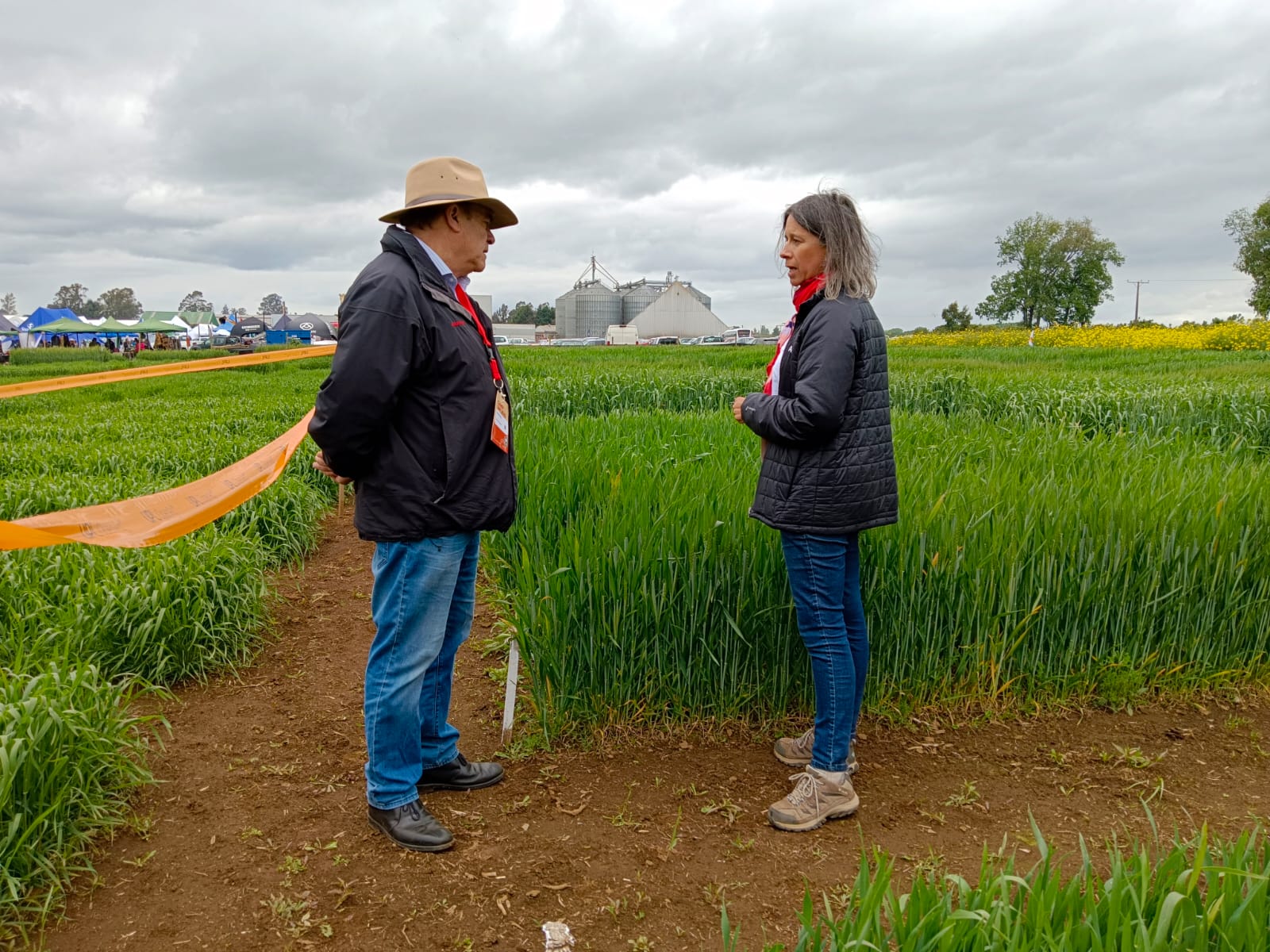
Through the PTEC-INVA, more than 80 farmers have already been integrated into regional networks of producers of legumes and oilseeds (such as lupine, canola and camelina), with active seeding in the regions of Araucania and Aysén.
Daniel Nieto Díaz-Muñoz, PhD
PTEC-INVA Technology Programme Managerdnieto@inva.cl
www.inva.cl

From the Technological Program for the Local Production of Nutritional Insumes for Aquaculture (PTEC-INVA), which is driven by the Corporation for the Promotion of Production of Chile (Corfo), led by Antarctic Salmon and co-executed by the Agricultural Research Institute of Chile (INIA), Agrotop Companies, Veterinary Histopathology Center (VeHiCe), the Food Technology Innovation Center (CeTA) and the universities of Chile (University of Chile) and Catholic University of Temuco (UCT), we would like to provide some reflections that complement and strengthen the vision of the Association of Salmon Industry of Chile (SalmonChile)of the Council of the Salmon of Chile (Director of Salmon farming) and the National Society for Agriculture (SNA) highlighting the strategic importance of the chaining of agriculture and aquaculture as a route to sustainable and inclusive development.
1. Not only a future alliance, a concrete and ongoing reality: Agricultural production chaining is not a distant aspiration. Through the PTEC-INVA, more than 80 farmers have already been integrated into regional networks of producers of legumes and oilseeds (such as lupine, canola and camelina), with active seeding in the regions of Araucania and Aysén. The objective: to produce local nutritional inputs for salmon farming, reducing the dependence of 85% of imported raw materials that today They characterize the industry.
2. Innovation that transcends food formulation: the work carried out by the PTEC-INVA has not only focused on replacing flour and fish oil with vegetable sources, but has also generated concrete innovations such as: (a) protein concentrates with more than 60% purity, validated in fish and with competitive costs; (b) dietary formulations that improve intestinal, bone, liver and immune health indicators in salmonids; (c) an industrial plant design with capacity of 16,000 tons/year of lupine protein concentrate, with positive technical and economic feasibility. This not only strengthens environmental sustainability, but also operational efficiency and national food sovereignty.
3. The scale of this challenge requires a country vision: we welcome the fact that leading agricultural and aquaculture associations are finding common ground. The challenge is substantial: producing locally the feed required by the salmon farming industry (1,250,000 tonnes a year) will require planned agricultural expansion, rural infrastructure, incentives for innovation and, above all, joint decision-making.
In this sense, the PTEC-INVA has demonstrated that it is possible to articulate science, enterprise and territory in a logic of circular economy of regional scale. Rather than double salmon production as a goal, we propose to consolidate a third national industry, combining the best of the sea and the land, of the science and the agricultural trade, with global standards and local roots.
4. Towards a national input strategy for aquaculture: Several actions have already taken place in the PTEC-INVA, from the so-called “Camp Days” with farmers to experimental validations in cages, from georeferenced maps of inputs to protein concentration technologies developed in Chile.
What we need now is an explicit country strategy that recognizes that food security also involves producing our own ingredients for fish food, in line with what global entities such as the Food and Agriculture Organization of the United Nations (FAOThey have already warned.
In short, There is already an advanced path, a validated model and a committed community. PTEC-INVA is available as an enabling platform for this shared vision to transform into a national policy of agro-acuculture chaining.