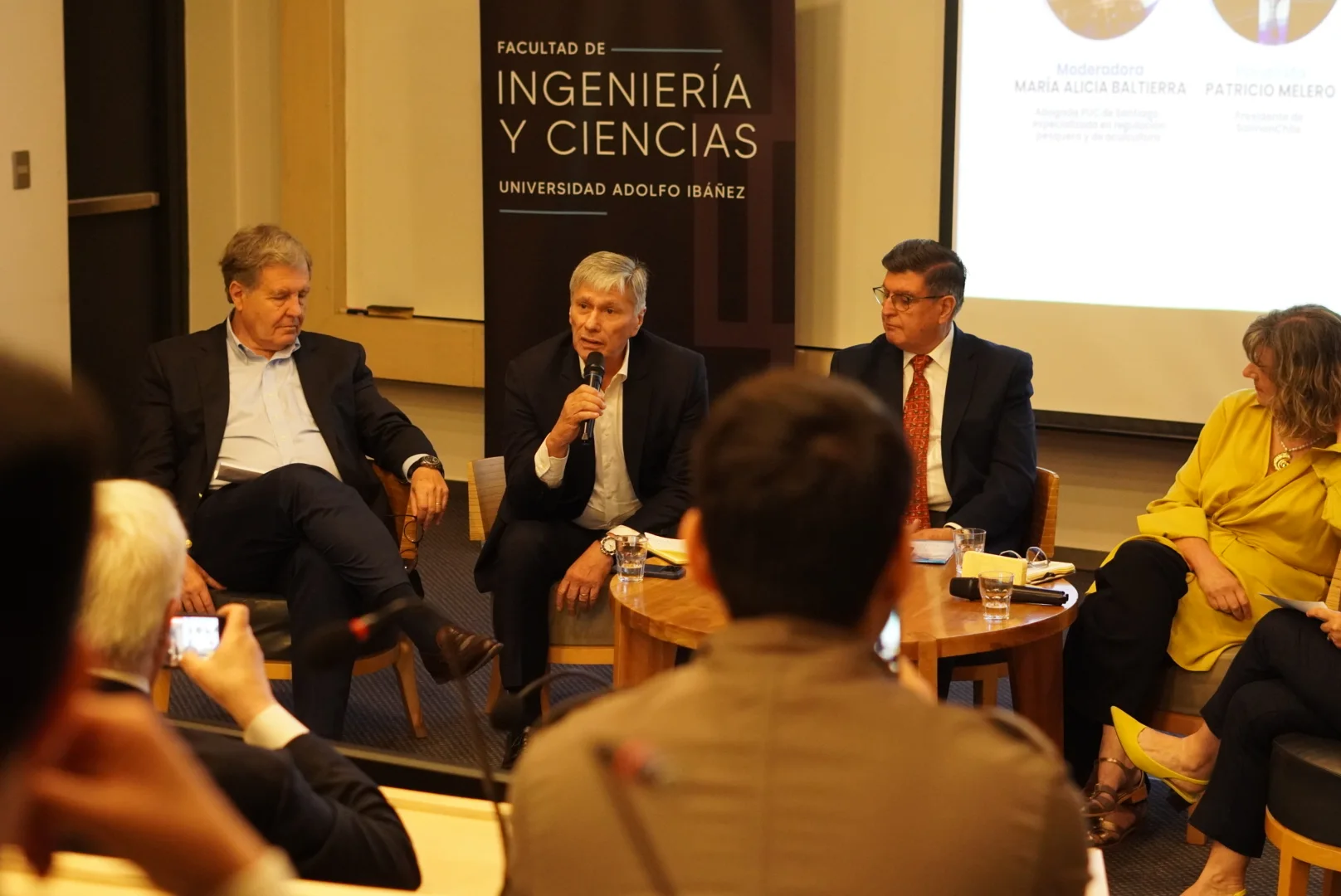
On Friday, November 20th, the seminar “The next leap of Chilean salmon farming”, organized jointly by the Faculty of Engineering and Sciences of Adolfo Ibáñez University (UAI) and the Club Innovación Acuícola de Chile, was held with the aim of analyzing the conditions necessary to resume sustainable growth, optimize regulatory frameworks and promote the adoption of cutting-edge tools.
The meeting brought together union leaders, executives of production companies, researchers and aquaculture specialists, who discussed the projection of the country's second export activity and its role in the dynamization of the regions of Los Lagos, Aysén and Magallanes.
During the day, the president of the partner company of SalmonChile Multi X, José Ramón Gutiérrez, explained about the four decades of history of the sector in the south of Chile, addressing the initial growth of the activity and the urgency of regaining the competitive position of the country in the international markets.
“The main challenge of Chilean salmon farming is to regain the competitiveness we have lost, because without competitiveness there is no sustainable growth. We have an activity that generates more than 330 thousand jobs, contributes nearly $7,000 million to the economy and is a huge asset for the country. We cannot let that potential be lost. We need will, a state that will help things happen and a concrete agenda that will allow us moving forward with what we already have, without the need for new concessions or to expand cultivation areas,” he said, adding that a central part of the current gaps can be resolved through short-term administrative and regulatory measures that optimize installed capacities.
For his part, the president of SalmonChile, Patricio Melero, relieved the value of these spaces of multisectoral dialogue in order to make known the productive reality of the sector and to advance in public-private agreements that guarantee long-term certainties. “Smoniculture is awakening more and more interest and that is good news. We are talking about the country's second export sector, an activity that generates employment, development and opportunities in many regions of Chile, but whose contribution is still little known. Today we have an important opportunity to advance the regulatory changes we need, to give greater legal certainty and to create better conditions for the investment and sustainable growth of salmon farming,” he said.
Legal certainty and world-class standards
In terms of regulation and sustainability, the panellists agreed on the urgency of having a modern, predictable and coordinated regulatory framework capable of adapting to the environmental, health and geographical dynamics in which national aquaculture operates.
On this point, the Chair of the Committee on Sanitary Standards for Aquatic Animals of the World Organisation for Animal Health (WHOA), Alicia Gallardo, emphasized the role of science and human talent. "To move towards more efficient aquaculture we need innovation and technology, but also different regulation, which creates incentives to research and develop new solutions. Chile has capacities extraordinary, both in animal health and in knowledge and human capital, and we must take advantage of them. We need to investigate to know what to measure, make better decisions and incorporate tools such as artificial intelligence, which can help us face the productive and health challenges of the sector,” he said.
Along the same lines, the legal adviser of SalmonChile, María Alicia Baltierra, underlined the value of projecting the structural strengths of the territory towards clear regulations. “Chile has extraordinary competitive advantages to further develop salmon farming, from the natural conditions of our fjords to the productive and human capacities we have built for decades. But it is not enough to recognize that potential. The real challenge is to define what decisions we need to make to realize it, to create greater certainty to invest and to move towards a more competitive, sustainable activity and able to continue to contribute to the country’s development,” he said.
Applied innovation: launch of a diploma in Artificial Intelligence
Within the framework of the sector's continued commitment to innovation and technological development, the Diploma in Artificial Intelligence Applied to Critical Decisions in salmon farming was officially presented during the day, a programme promoted by the IAU and the Aquaculture Innovation Club, under the direction of Samuel Varas and Adolfo Alvial.
The academic initiative - which will start its classes on May 18, 2027- is aimed at professionals from producing firms, network of suppliers, public entities and R & D centers. Its training plan will address digital strategy, advanced analytics and the resolution of productive and health challenges through practical projects in real environments.
In relation to this training tool, Alicia Gallardo stressed that “monoculture faces increasingly complex challenges and to address them we need better tools, more research and professionals prepared to make evidence-based decisions. Artificial intelligence opens enormous opportunities to advance in matters such as animal health, productive efficiency and information management. This is why initiatives such as This diploma is so important: because investing in people’s capacities is also investing in the future of Chilean aquaculture.”