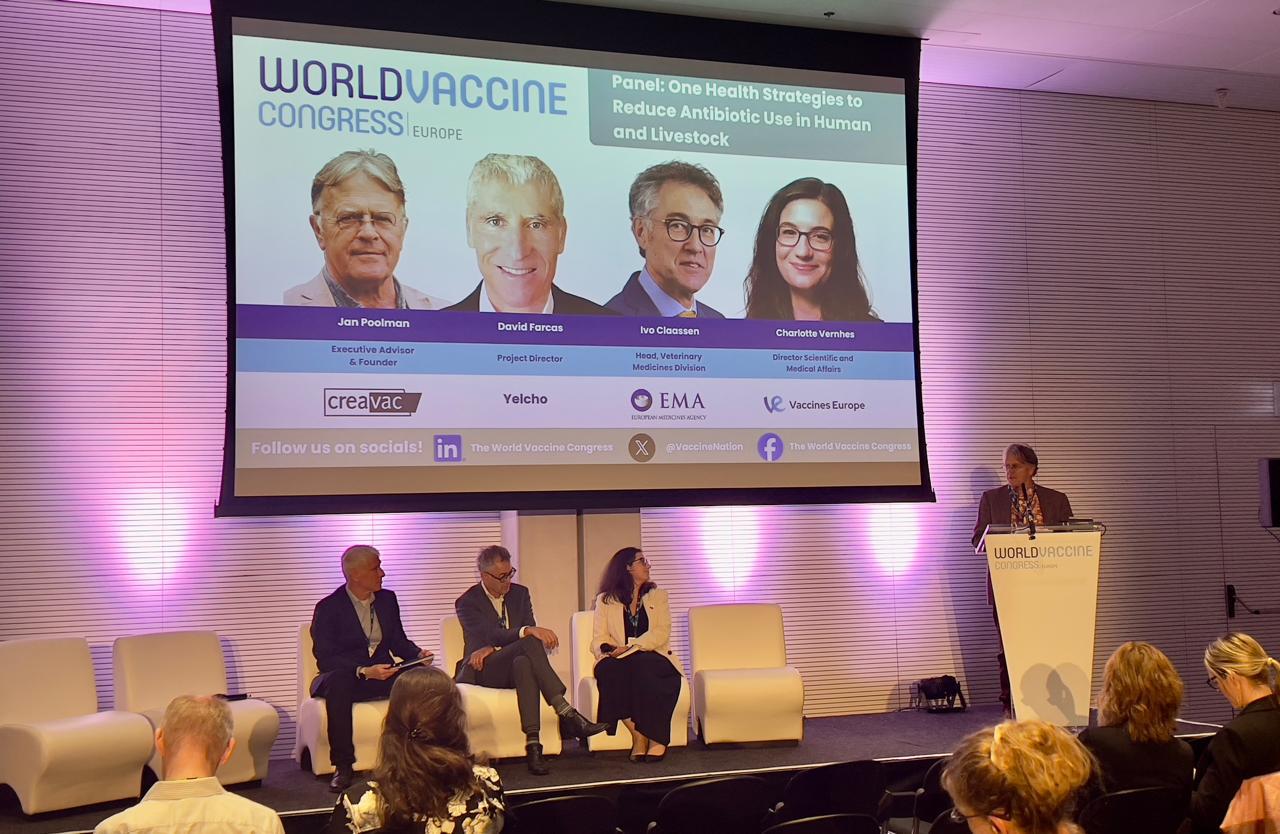
The director of the initiative, David Farcas, traveled to Europe to participate in this meeting where he took part as a panelist in the session "One Health Strategies to Reduce the Use of Antibiotics in Public and Animal Health."
As a valuable opportunity to identify and call upon new pharmaceutical companies capable of developing solutions to prevent and control the Piscirickettsiosis (SRS) in Chilean salmon farming was rated David Farcas, director of the Yelcho Alliance, the recent European World Vaccine Congress
The meeting, held between October 13 and 16 in Amsterdam, Netherlands, brought together more than 2,500 attendees and addressed issues that covered the entire value chain of human and animal vaccines, from basic research to commercial manufacturing, along with the most recent advances in each area.
In plenary “One Health Strategies to Reduce Antibiotic Use in Public and Animal Health” Presentations were made on the role of combined vaccines and new platforms against bacterial infections; successful cases of measurable reduction in the use of antibiotics through vaccination; management strategies; advances in biosafety protocols; global standards to harmonize antimicrobial resistance control (RAM); as well as specific approaches for aquaculture species, poultry and pigs.
David Farcas was part of the plenary panel moderated by Dr. Jan Poolman, executive adviser and founder of CreaBacVac B.V., company specializing in research and experimental development in biotechnology. Dr. Ivo Claassen, Head of the Veterinary Division of the European Medicines Agency (EMA), and Charlotte Vernhes, Director of Scientific and Medical Affairs of Vaccines Europe, specialised research group on vaccines in the European Federation of Pharmaceutical Industries and Associations (EFPIA).
“I was invited to present Yelcho’s experience and objectives, placing special emphasis on the importance of public-private partnerships to drive vaccine innovation. Our main objective was to position Yelcho as an attractive consortium for the incorporation of new laboratories and actors in the sector. Although the congress is focused on 95% human health, which makes it difficult to concentrate on animal health, our participation was key, especially in the exploration phase we are in, where we are constantly in search of new allies,” explained the executive.
He added that the project aroused great interest among the participants. “We show Yelcho as a unique alternative, where laboratories can develop vaccines for SRS under extremely privileged conditions, by bringing together the state and customers – salmon companies – in a consortium, ready to sit at the table, dialogue and work together.”
He indicated that, although several cases were presented in other species, Yelcho highlighted in terms of the power of public-private collaboration, since the initiative involves the state, laboratories, salmon producers and even universities. Also, the scale of the initiative, with a potential market estimated at 250 million doses per year, surprised the attendees, who highlighted its innovative model.
He added that participation in Congress also generated three important advantages: “To strengthen links with executives of companies with which we are already working, to expand the network with new contacts and to reach out to representatives of pharmaceutical companies that we want to invite to the project, thus widening the spectrum of laboratories interested in the initiative.”
The director of Yelcho described the World Vaccine Congress as one of the main meeting points of the global pharmaceutical industry, regulators and technology providers. “It is the global cluster of the vaccine industry, where suppliers, manufacturers and authorities meet. It is a unique space to generate relevant advances through ongoing conversations and opportunities for networking“ ” he said.
Finally, he emphasized that, thanks to the participation in the meeting, dialogues were made with laboratories interested in deepening their knowledge of the project and also with applied research companies, willing to provide prototype vaccines for SRS. “Our main goal is to convene more pharmaceutical companies, so we will continue to make progress in this exploratory stage. Participate in events such as the World Congress was very useful in expanding our reach and spreading our initiative to new audiences,” he concluded.