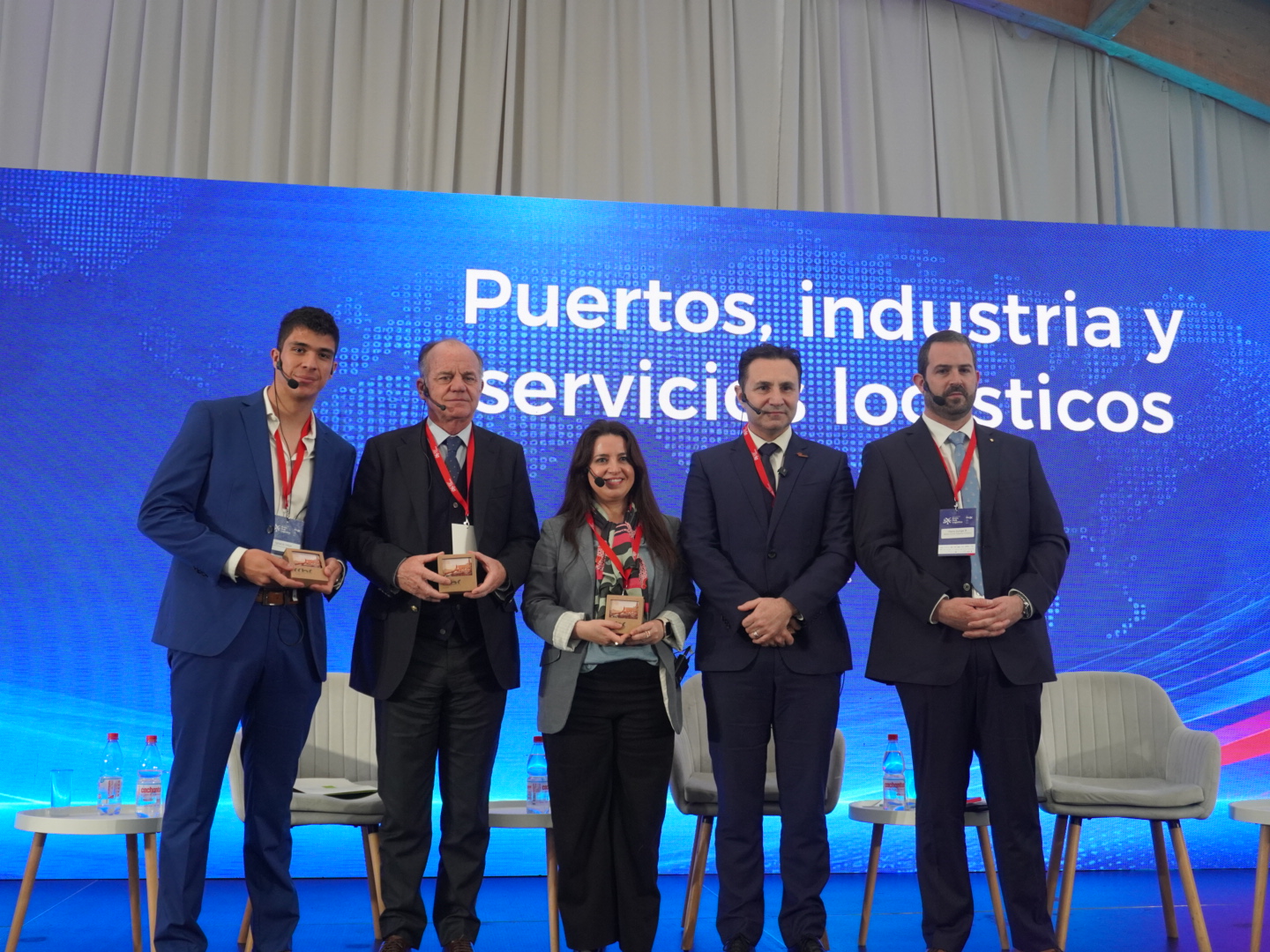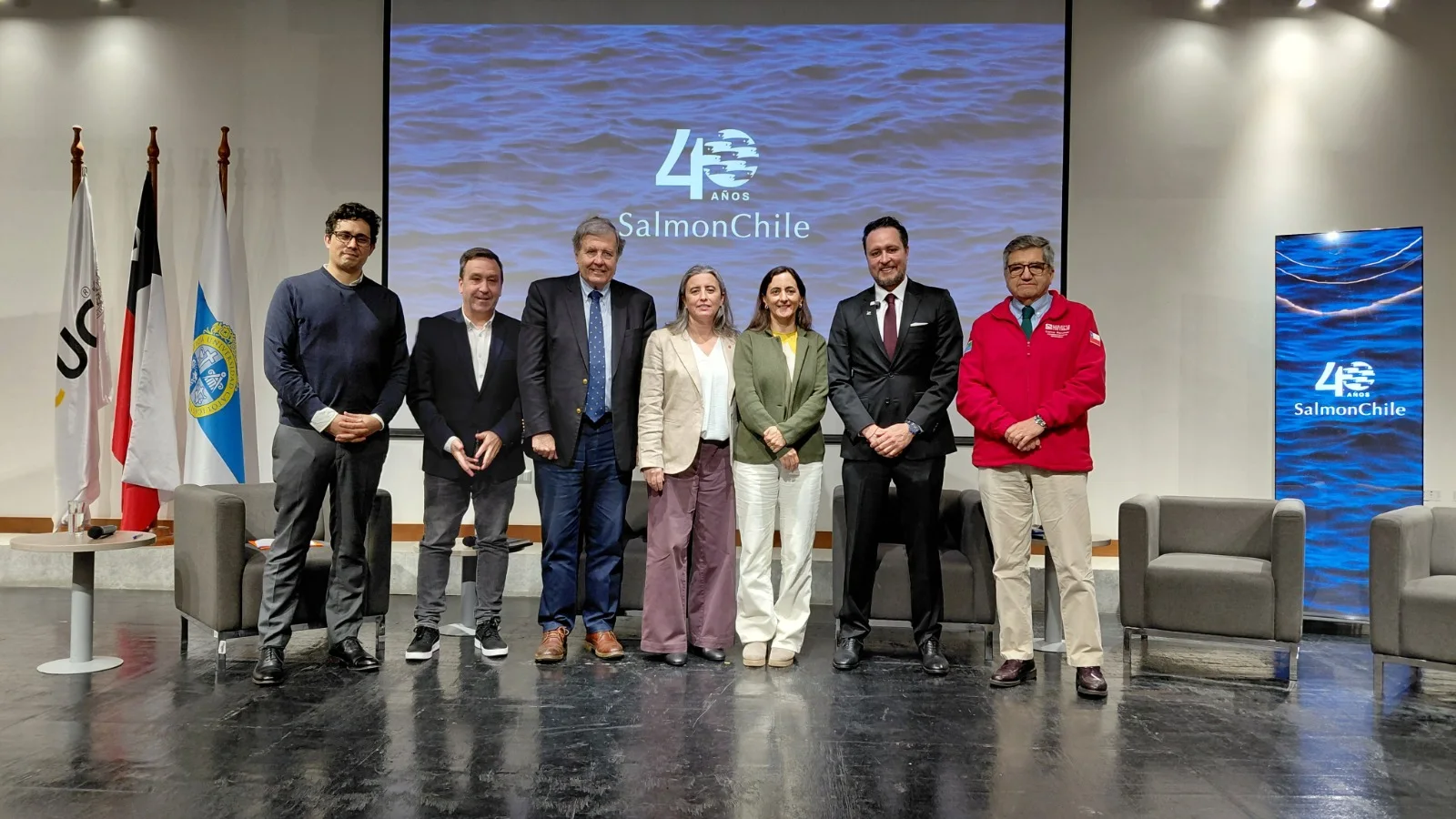
SalmonChile presented in Puerto Montt the study entitled “Economic contribution of the salmon industry in Chile”, with the aim of making known a comprehensive update on the productive, social and regional impact of salmon farming in the country. The meeting took place in the premises of Duoc UC Sede Puerto Montt and brought together local authorities, academics, union leaders and representatives of the productive sector.
The day began with the opening remarks of the regional governor, Alejandro Santana, followed by the speech of the president of SalmonChile, Patricio Melero, and had as main speaker the economist and co-author of the research, Francisco Carrillo, MPP of the University of Oxford and partner of CoMov Consultores. After his presentation, a discussion panel focused on analyzing the scope of the study and the challenges of the territories, composed of the president of the Multigremial Nacional de Empresadores, Juan Pablo Swett; the former minister of agriculture and director of Food and Forestry at SEDE-UAI, María Emilia Undurraga; the mayor of the commune of Puerto Montt, Rodrigo Wainraihgt; and the regional administrator of Los Lagos, Carlos Recondo.
In the instance, Carrillo detailed the methodological scope of the research and highlighted its main findings. “SalmonChile had a very good idea, which is to identify well where the economic value of this industry lies. We build, through data, the economic footprint. What does it mean to build the economic footprint? It involves knowing where the cultivation, processing and all the interrelations, both labor and suppliers, which exist. The results are surprising. 2.6% of Chilean GDP is explained by the salmon industry, as well as 3.8% of jobs,” he said.
For his part, the president of SalmonChile, Patricio Melero, appreciated the strategic weight and territorial scope of activity in the country's economy today. “This study shows that salmon farming has been installed not only as Chile’s second largest export product, but already generates 2.6% of gross domestic product, 7 billion dollars, and generates more than 330 thousand direct, indirect and linked to the activity. And that gives us a series of tools to see where that productive process is developing from. It is very interesting to see that more than 60% of the contribution to GDP is made just outside the southern macrozone,” he said.
Impact and strategic relevance in the Los Lagos Region
Among the main results of the report is that the sector contributes USD 6,956 million to the national GDP (2.6% of the total) and maintains 337,670 jobs in the country (3.8% of the total), of which 78,808 correspond to the direct core - divided between cultivation centers and processing plants - and 258,862 to indirect posts generated through suppliers, logistics, transport, trade and services.
The study also highlights a marked multiplier effect. For every direct employment generated in the southern southern part of Chile, 3.3 additional jobs are held in the Chilean economy. Also, out of every 100 pesos contributed to GDP, 65 are generated in indirect activities - outside the cultivation centers and plants - concentrating most of the added value on processing and manufacturing links.
At the regional level, the report presented in Puerto Montt shows the weight of activity in the Los Lagos region, where it contributes USD 1,166 million – equivalent to 12.6% of regional GDP – and sustains 47,279 jobs, representing 15.2% of local employment. In the territorial breakdown, the province of Llanquihue is positioned as the main logistic and operational center of the sector, and generator of almost half of the contribution national direct, adding USD 853 million (14.3% of provincial GDP) and 34,339 jobs (17.3%). For its part, in the province of Chiloé the activity shows an even deeper penetration by explaining 19.2% of the territorial GDP (USD 169 million) and 21.6% of the labor force (8.863 workers).
The dynamism also extends to the province of Osorno, with a contribution of USD 138 million (5.9% of its GDP), and to Palena, where it generates USD 7 million (14.9% of provincial GDP) and 307 jobs (12.0%), confirming salmon farming as the most cross-cutting socio-economic pillar of southern southern territory.
Visions and reactions from the public sector and trade unions
Regarding this milestone, the president of the National Multigremial, Juan Pablo Swett, highlighted the decentralized impact of the sector. “Chile is a tremendously economically concentrated country in Santiago. Salmon farming shows that it is possible to generate development from the regions, boosting entrepreneurship, SMEs and employment. What happens in the south with this activity is an example for the rest of the country (...) represents 2.6% of national GDP, but its impact on the world of SMEs is proportionally much higher. We are talking about an activity that generates opportunities for thousands of supplier companies and whose growth has a multiplier effect on the regional economy,” he said.
For her part, the former Minister of Agriculture, María Emilia Undurraga, raised the importance of reconciling growth and sustainability. “When one says to lower permission, it is not to lower standards. We need high environmental and social standards. But that doesn't mean they're not agile, fast, for sure. We need to get out of this dichotomy of growth or conservation (...) We need clear rules, agile rules allow us, with those standards, to generate the sustainable industry of the future. Not only do we have to see what there is, but what it could be,” he said.
Meanwhile, the mayor of Puerto Montt, Rodrigo Wainraihgt, valued the results of the report and its relevance to employment. “It is important this study that confirms what we have been doing with the Salmon Plan 2050, the importance of industry not only in Puerto Montt and the Los Lagos region, but also in Chile. Today we are talking about an industry that generates about 330 thousand jobs and that currently does not exist any another industry that can replace it, and that’s fundamental,” he said.