Researchers, industry representatives and public sector officials will analyze the main challenges of Chilean salmon farming in a meeting organized by the NENRE-EfD program of the University of Concepción. The discussion will address the sustainability of the activity, animal health and policies that influence its development.
Chilean salmon farming faces a scenario marked by new environmental, health, regulatory and productive challenges. With the aim of promoting informed dialogue and the generation of proposals from different perspectives, the XII NENRE-EfD Chile Annual Meeting will develop the policy panel The Challenges of Salmon Farming in Chile, activity that will take place next 6 November 2026, at 10:15, at Hotel Termas de Catillo.
The body is part of the official program of the meeting organized by the Natural Resources and Environmental Economics Research Program (NENRE EfD-Chile), initiative dependent on the Vice-Rectorate of Research and Development (VRID) of the University of Concepción, in collaboration with the international network Environment for Development (EfD). The event has become one of the main academic discussion spaces on environment, natural resources and public policies in Chile.
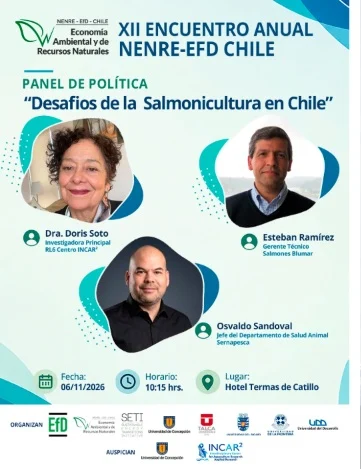
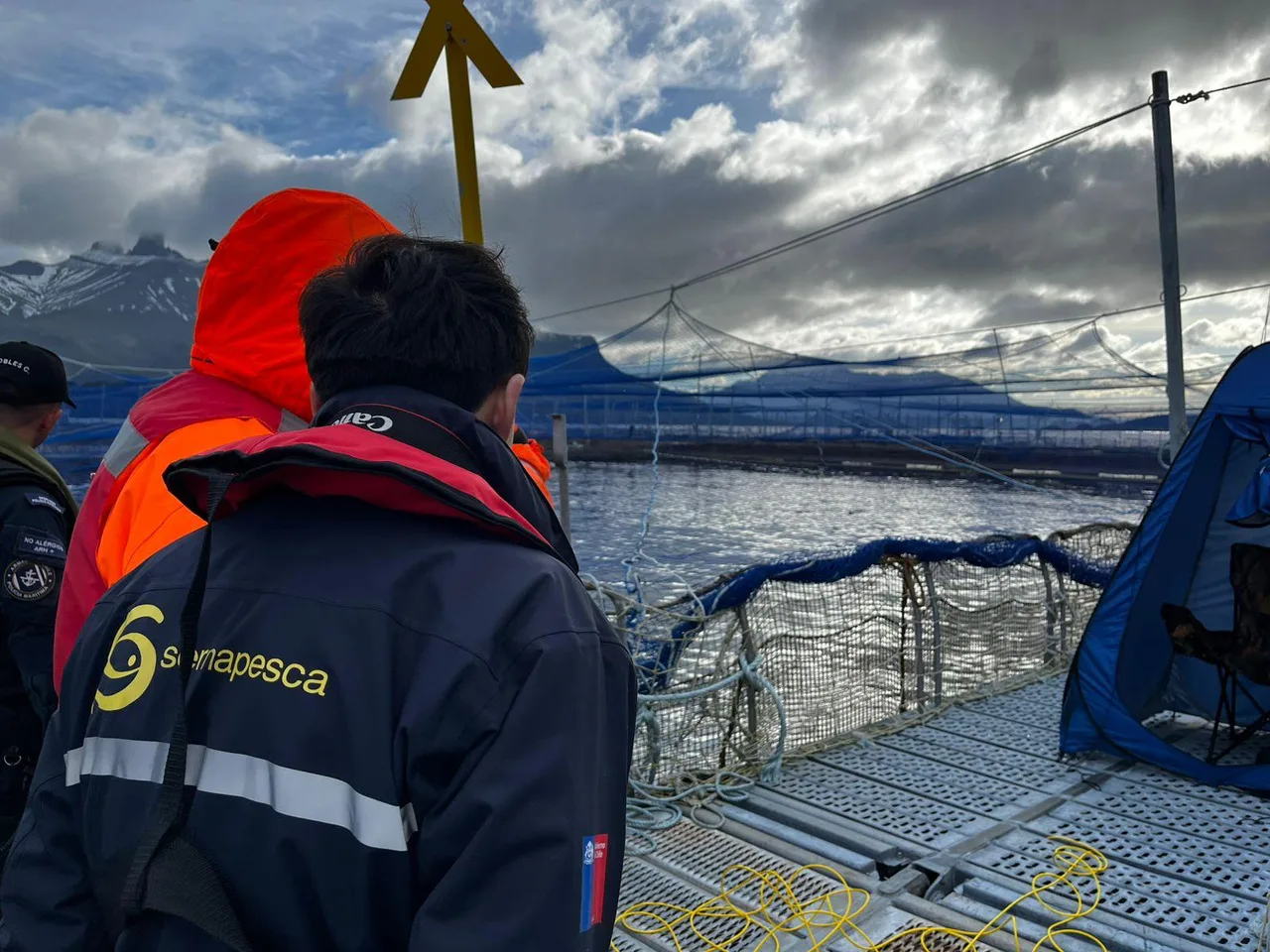
The panel will be composed of prominent representatives from different areas linked to the development of national aquaculture. Participating will be the Dr. Doris Soto, principal researcher of the sustainability line of aquatic systems at INCAR² Centre; Esteban Ramírez, technical manager of Blumar Salmons; and Osvaldo Sandoval, head of the Animal Health Department of SernapescaThe conversation will allow to compare scientific, productive and regulatory views regarding the main challenges faced by the sector.
The activity takes on special relevance considering that aquaculture will have a prominent presence within the event's program. Among the topics to be addressed during the day are aspects related to sustainability, animal health, productive efficiency, international trade and adaptation to new environmental scenarios, all key factors for the future of Chilean salmon farming.
Similarly, the program includes the participation of national and international experts who will analyze various economic and environmental aspects related to natural resources. Among them is the presence of the renowned fisheries and aquaculture economist Frank Asche, one of the main global references in aquaculture economics, whose participation will provide a global perspective on the challenges and opportunities facing the industry.
From the organization they point out that the discussion around salmon farming is particularly relevant in a context where the sector seeks to move towards more sustainable development models, incorporating scientific evidence in decision-making and strengthening the coordination between research, state and industry.
The XII NENRE-EfD Chile Annual Meeting has the support of the University of Concepcion, Talca University, Bío-Bío University, La Frontera University and Development University. In addition, it is sponsored by the University of Concepcion and the Interdisciplinary Center for Aquacultural Research – Applied Research, INCAR², reaffirming the commitment of these institutions to the generation of knowledge for the sustainable development of the country.
People interested in participating in the event and learning more about the full program can obtain more information at the official website of the eventThe panel "The Challenges of Salmon Farming in Chile" is projected as a valuable opportunity to discuss the present and future of an strategic activity for the economy and territorial development of Chile.