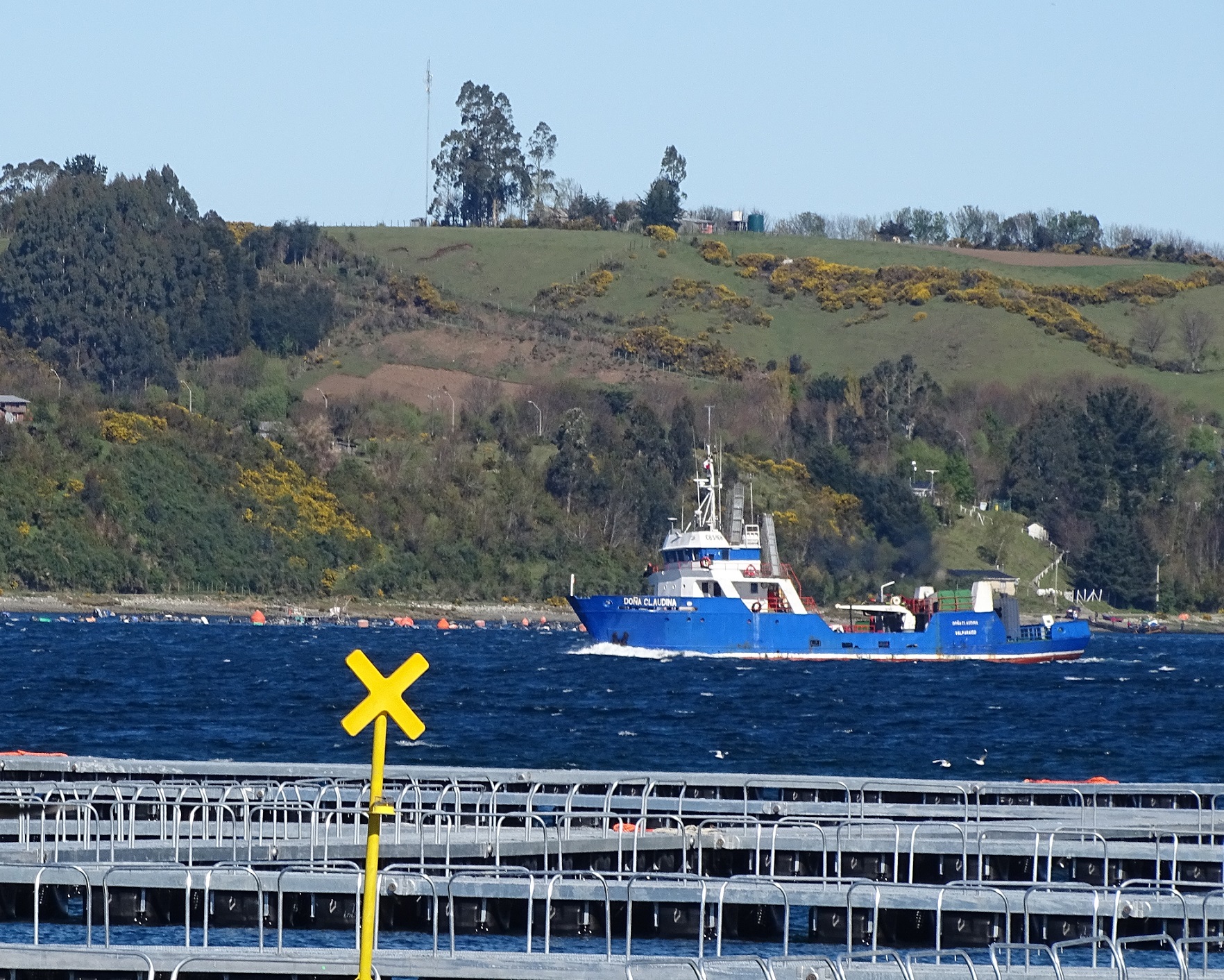
System would be based on the development of risk matrices to compare all ACSs with each other, and project the management of the activity with the aim of reducing environmental and productive risks.
The INCAR Center released the details of its proposal for a traffic light system to regulate salmon production in Chile, which is based on the assessment of the risk of losing environmental quality and ecosystem health, including the health and well-being of fish in cultivation, considering existing and available scientific information.
The research entity indicates that "there are realities and myths about the impacts of salmon farming on the inland seas of southern Chile. The public image of the sector, and often the opposition to salmon farming, is strongly influenced by fears regarding possible significant impacts of activity on ecosystems. Clearly we cannot rule out the existence of these impacts, which can be punctual, cumulative and/or synergistic considering the scale and intensity of operation of the industry; however, the scientific background available at the ecosystem level is generally very limited."
According to the INCAR Center, the models used for the purpose of studying the dispersion of dissolved and particulate material, i.e. fecas, nutrients, antimicrobial compounds, pesticides, among others, and current regulations, regulate and control the effects of these materials under the cultivation rafts and on the immediate space environment of each concession. However, we do not know the fate of the nutrients generated by the production of salmon, and we do not have validated models for estimating eutrophication effects that damage the pelagic environment and benthic communities on the scale of Groups of Salmonidae Concessions (ACS) or relevant water bodies such as fjords, breasts, canals, etc., which can affect the globally unique biodiversity of such ecosystems. The oceanographic complexity of the fjords and channels of southern Chile requires that more and better scientific knowledge be generated considering the particularities of each of them, since the information currently available about their environmental condition is partial and incomplete. So both, with existing scientific knowledge, we cannot directly establish the capacity and limits that these ecosystems have to sustain a specific production of salmon, nor can we assess how much production could grow without generating irreversible impacts on these ecosystems and on the fish in cultivation themselves. This ceiling is often considered to be the “productive load capacity” of the body of water. If it were we would have the confidence that the sector could grow without causing significant damage. Similarly, if it could be assessed at the scale of ecosystems that the productive load capacity is exceeded, production must be reduced to levels suitable for ecological and productive sustainability.
Since it is not currently possible to estimate these limits, the proposal of the Interdisciplinary Center for Aquaculture Research (INCAR) for a “semaphore system” to regulate salmon production in Chile, is based on the assessment of the risk of loss of environmental quality and ecosystem health, including the health and well-being of fish in cultivation, considering existing and available scientific information.
The proposal is based on the development of risk matrices to compare all ACSs with each other, and to project the management of the activity with the aim of reducing environmental and productive risks. The system considers the use of information such as cumulative production, use of antimicrobials and pesticides. In addition, mortality indicators are included to estimate the risk to the health and well-being of fish under cultivation. A important element of risk analysis is given by the sensitivity components of ecosystems considering key oceanographic and biological factors such as water renewal rate, oxygen levels in the background, stratification, history of harmful algal blooms and projections of climate change. Moreover, operating on the basis of the precautionary principle, the analysis pursued by the risk assessment and minimisation considers exposure, that is, the component that we can lose of biodiversity and ecosystem services, assuming a maximum uniform value for all ACS.
In order to draw up the risk matrices, it was necessary to organize information from and kindly delivered by various sources including public institutions (official information; SUBPESCA, Sernapesca, IFOP) and private (INTESAL) in order to build a database that integrates productive, health, environmental, oceanographic and climate information at the scale of cultivation centres and ACS from 2010. This effort required extensive review, standardization and ordering of information resulting as the first product a database whose content and information architecture can be used to generate new knowledge from it; and in addition to making public and private decisions in a prompt and timely manner.
The preliminary results of the analysis show a group of CSAs with higher levels of environmental and productive risk. The calculated risk levels are strongly influenced by the productive history and management of each area, oceanographic and climatic factors. Risk values tend to be lower in ACS with greater marine influence and towards the Magellan Region. While estimates represent only risks The information generated allows to focus actions to reduce risk in those most critical and relevant situations, while the possibility of increasing production in areas of lower risk can be explored.
Can we use these risk levels to implement a traffic light system to regulate the management of salmon farming and its production by ACS?. The answer is yes, but the proper functioning of a system such as the one proposed requires validation based on a participatory discussion instance to decide acceptable risk levels and the tolerable cut-off points or risk thresholds to grow, maintain, or reduce the salmon production in the ecosystem. Also, and seeking the necessary flexibility and adaptive solutions, the proposed model involves various measures that can be applied in an alternative way to the reduction of production against certain assumptions. For example, it is estimated that in certain scenarios it would be feasible to reduce the risk without reducing production, for example by reducing the use of antimicrobials and pesticides.
To validate the developed risk model and the estimates generated, environmental monitoring is necessary in some of the ACS, especially in those with the highest risks. Attention should also be focused on identifying response variables at ecosystem scale.
It is important to note that, while the proposed risk model does not directly involve risks associated with leakage impacts or interaction with macrofauna, such as sea lions, whales and other species, some of the variables considered in the model could be used as indirect indicators, for example, cumulative production by area and its distribution in space.
The risk model presented is simple, objective, and has been developed on the basis of existing scientific information, and is especially effective in guiding and integrating reflection and discussion within the public, private and civil society spheres, moving towards a public-private discussion in participatory processes with a vision of the future and balancing socio-economic development objectives with environmental objectives. This will help guide and coordinate efforts to monitor, monitor, investigate and improve current regulations, tending to reduce environmental and productive risks while increasing social benefits.
One of the major challenges of the traffic light proposal is associated with the fact that risk reduction in some ACS could involve a redistribution of salmon production in space and time, which implies a change in the current regulatory model of concessions and authorized productions, which are associated with specific sites without greater flexibility. In this way, it appears as a necessary condition for the operation of the system the relocation that allows to move production, if necessary, to areas with lower risk and better conditions for the exercise of the activity, with the corresponding environmental and sanitary reserves. Relocation has been hampered by the adoption and successive implementation of a number of uncoordinated policies and approaches, requiring policy adjustments and the formulation of a shared objective to ensure its effective implementation. It is estimated that this will be possible insofar as relocation is part of the production traffic light model that is resolutely oriented towards the sustainable exercise of salmon farming, based on robust research, objective and transparent information and developed under a framework of known and shared rules.
In addition, a model such as the one described above requires that a series of regulatory adjustments be made, ranging from regulatory regulations and resolutions to legal amendments, not all of which need to be enacted and implemented at the same time. In this way, it is perfectly possible to foresee an agenda of regulatory adjustments that, together with the implementation of pilot experiences, allows to validate the model in function of empirical results obtained and generate knowledge and experience, so that more in-depth regulatory adjustments, such as legislative ones, are carried out when useful information is available to guide their definitive design.
With progress since mid 2018[1], the current proposal for a roadmap that we have set out as INCAR considers generating an agreement or instance of cooperation with Sernapesca-SUBPESCA to transfer and implement the database and information architecture. This will facilitate the implementation of a Adjusted integrated monitoring system at estimated risk levels. This system requires adequate and necessary funding and human resources to promote and strongly encourage sustainable, up-to-date and forward-looking aquaculture.
In addition, it is necessary to:
- Continue efforts to improve the environmental and health risk classification ACS and/or relevant water bodies with the best information available to represent the health of these ecosystems.
- Test, explore and validate traffic lights cut-off points with a pilot evaluation, i.e. to validate the threshold values that when passed on generate the changes of lights, which finally represent the ecosystem health status. For example, comparing two high-risk ACS with two low-risk ACS using some ecosystem response indicators that are possible to be defined.
- Test one pilot implementation of the traffic light system in at least four ACS, which would involve ordering productive management and taking appropriate measures to address environmental and productive risk levels in the crop centres involved in accordance with established targets.
- Develop a proposal for a communication platform about the traffic light system with transparent information, with wide diffusion and effectiveness as a powerful tool to inform public opinion about the health of the ecosystems in which salmon are grown.
In INCAR's proposal, the specific design, implementation, and evaluation of a traffic light system to regulate salmon production should take into account the socio-economic effects and possible opportunities that may arise from proposed regulatory changes. Among the key elements to be taken into account in the design and analysis of the effects of a traffic light system are the organisation of the industry in its vertical stages (fish farming, cultivation/production, processing, and marketing), its relations with other industries providing services (food, fish health, transport, and other logistics), as well as the current geographical configuration of its operations. Similarly, the design and analysis of the effects of a system such as the one proposed should consider, among other aspects, the potential impacts on the supply of salmon (and specific products derived from salmon), exports, and employment (direct and indirect) and workers' incomes.
Preliminaryly, it is possible to identify that the effects that the system can generate as the proposed one will depend on the following key elements: a) the detail of the traffic lights system and its specific implications; b) the way in which companies will react to the modification of the regulatory framework and the particular situation they face, including their current possibilities of production and use of geographical space (e.g. (c) the relationship between the production/cultivation activity and the other stages of the industry (fish farming, marketing processing and other related industries). Finally, from an economic point of view, it is also relevant to define the associated costs (“administration costs”) for the design, implementation and evaluation stage of the system and to ensure its adequacy. financing.
The major challenge for aquaculture at national level is to manage the sector by balancing progress towards sustainable development goals, taking into account, in particular, the unique biodiversity of our aquatic environments and the threats posed by climate change.
The proposed system requires a significantly greater investment in funds for the research, monitoring and implementation of the system. Without a doubt, our ecosystems and Chilean aquaculture deserve it.