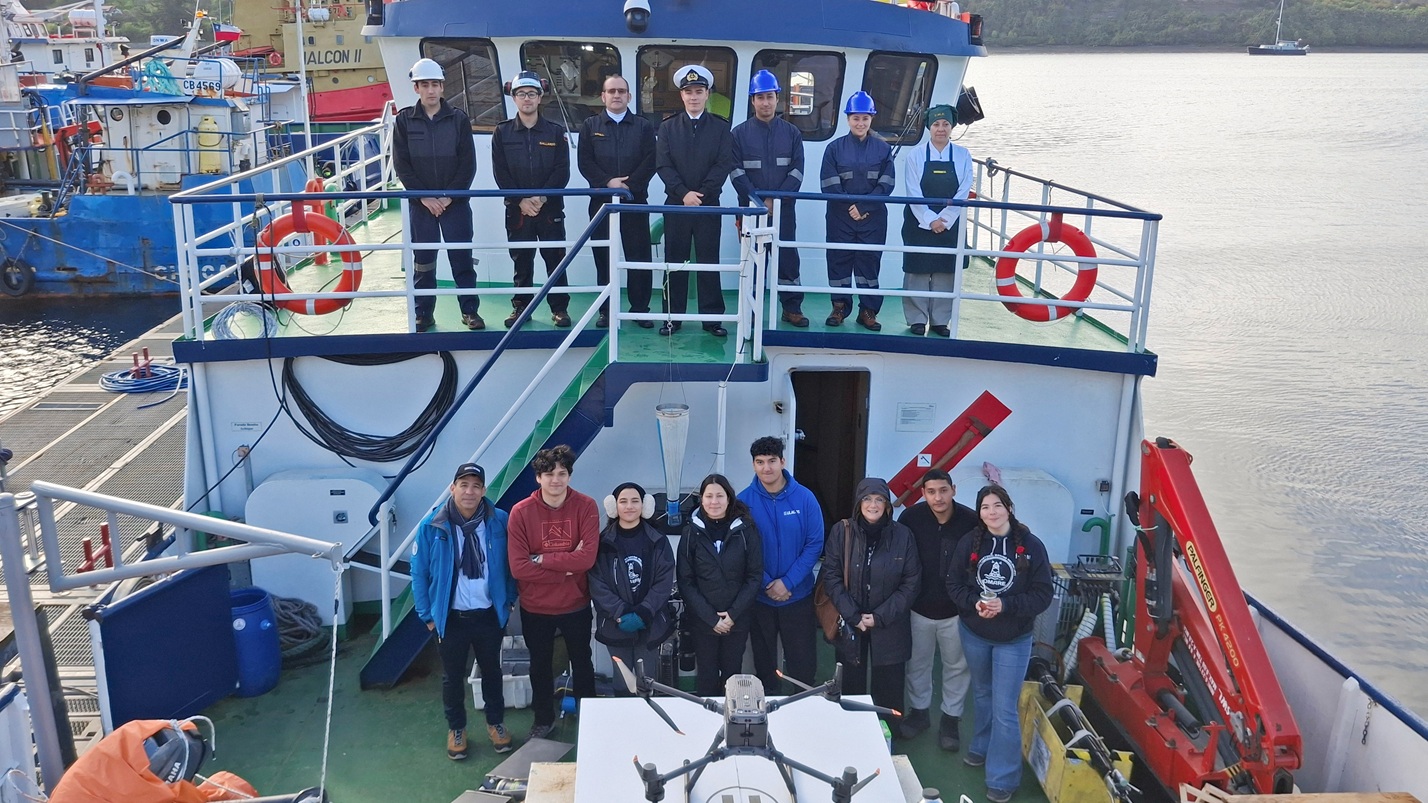
The study is part of a Fondecyt project led by Dr. Carlos Lara of the Faculty of Sciences of the Catholic University of the Holy Conception (UCSC).
“Bio-optical gradients along the coastal estuary-ocean river of North Patagonia”, is the name of the project ANID Fondecyt Regular (N°1230420) of the researcher of UCSC Dr. Carlos Lara. In this context, a visit was received from Dr. Aline de Matos Valerio, of the National Institute of Space Research (INPE) of Brazil, who participated in a field trip to the Seno de Reloncaví, to contribute the topic of bio-optics in the Study.
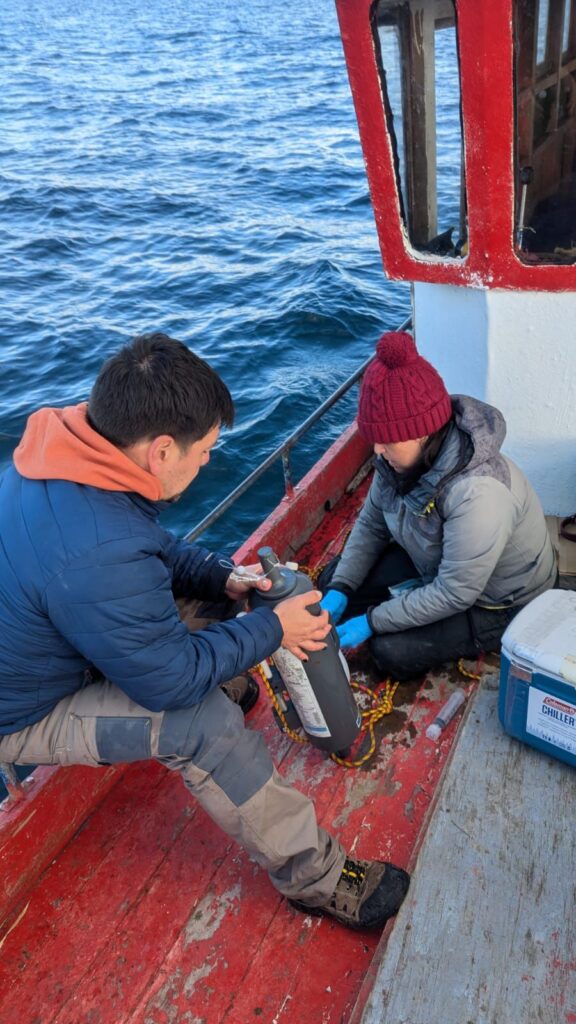
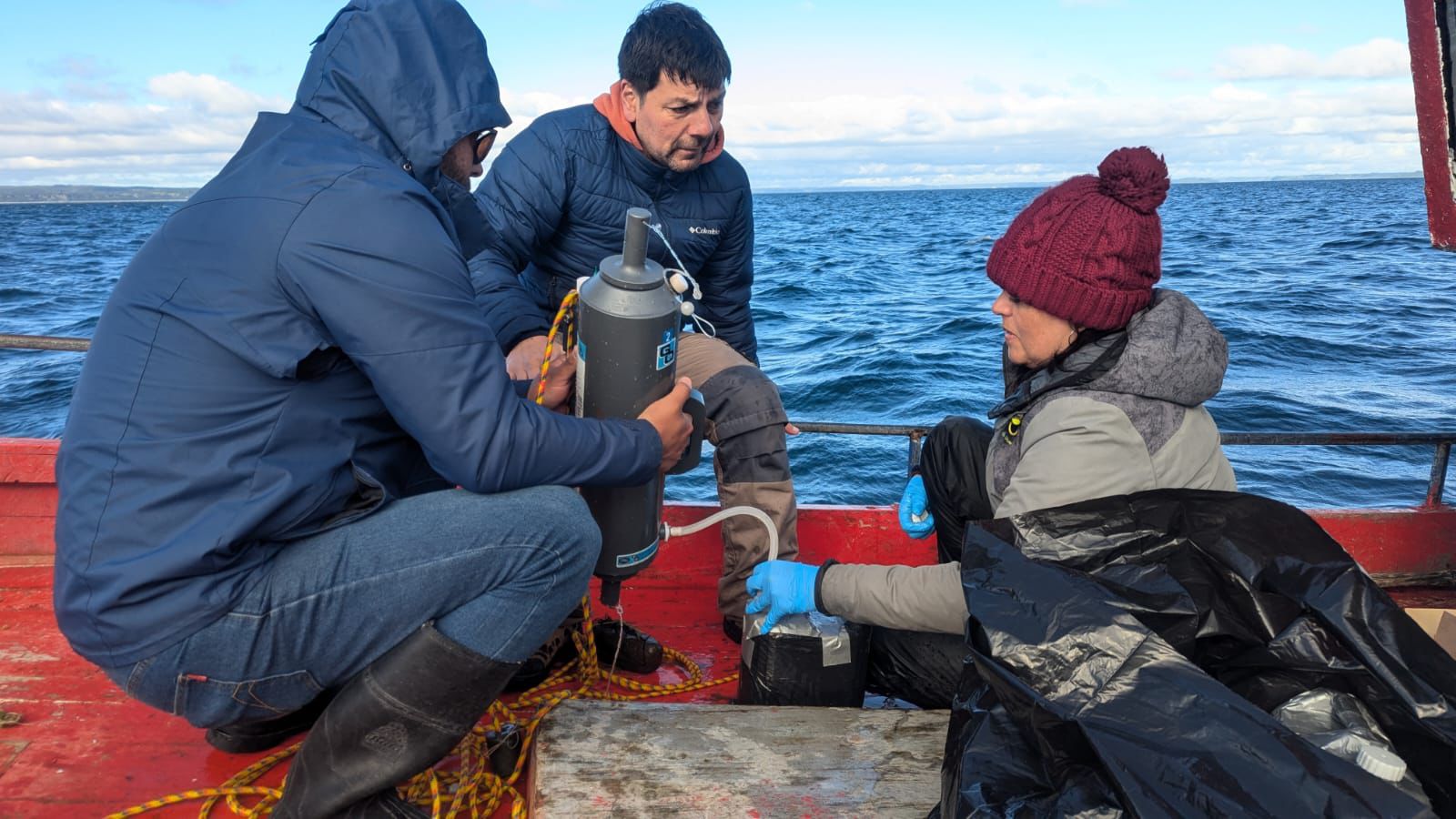
It is understood as bio-optical the constituents of water that cause a change of color continuously. “We took measurements of chlorophyll, nutrients and radiometry. The idea behind it is that we can relate these optical constituents that cause the change of water color to radiometry, and then be studied by satellites to monitor the area,” explained the researcher.
The project seeks to understand how the bio-optical properties, the optical properties of an aquatic system can vary in time and space in a complex environment. Most of this knowledge is focused on the northern hemisphere and from there was born the idea of studying this phenomenon in Northern Patagonia.
“We hope to diagnose potential changes in the magnitude of these properties and processes that have a specific biogeochemical significance in the optically complex waters of northern Patagonia. Our unique high-resolution data measurements will also allow us to validate satellite observations to estimate water quality parameters,” said Dr. Carlos Lara.
Work on the ground
For three days water samples were taken from the Seno de Reloncaví. Dr. Aline de Matos Valerio will contribute from the remote sensing of the color of the water. “I have been working on this subject since 2005. My knowledge is related to the sampling of the bio-optical part, radiometry and knowledge of how to obtain this information through satellites,” added Dr. From Matos Valerio.
Usually, it works only from the point of view of the river or the ocean, but rarely is it analyzed continuously. That's one of the added values of the project. “It is not very common for it to be studied in an interconnected way. In this way, we study both the river, as well as the coast and the ocean, since everything is connected. My knowledge is much more integrated. I think that’s my contribution to this project,” he added.
Regarding the importance of the theme, through remote sensing and the colour of the water you can understand all its evolution. By means of satellites you can have a broader vision, which helps to carry out monitoring and dynamics. “Constituents in the water change their color. For example, if there is more phytoplankton the color becomes greener. If there is more organic matter it is darker or yellow. With sediment becomes more red. When we understand how it works with the light that comes into the water and interacts, we can understand what is in the water and how its dynamics is. Satellites measure what the sunlight reflects,” he concluded.
Thus, thanks to this technique, the changes that a marine ecosystem has had over time can be identified, in addition to the influence of climate events such as El Niño or La Niña and even very strong rains.
In addition to the ecological factor, studying this phenomenon also has an economic interest in the species that live around the sector. “Through samples, light and color, models can be made to make projection into the future or to find out what it was like before. In this sector there are toxic algae that pollute in addition to the salmon or choritos industry. We must be very aware that they do not become contaminated,” he said. academic.