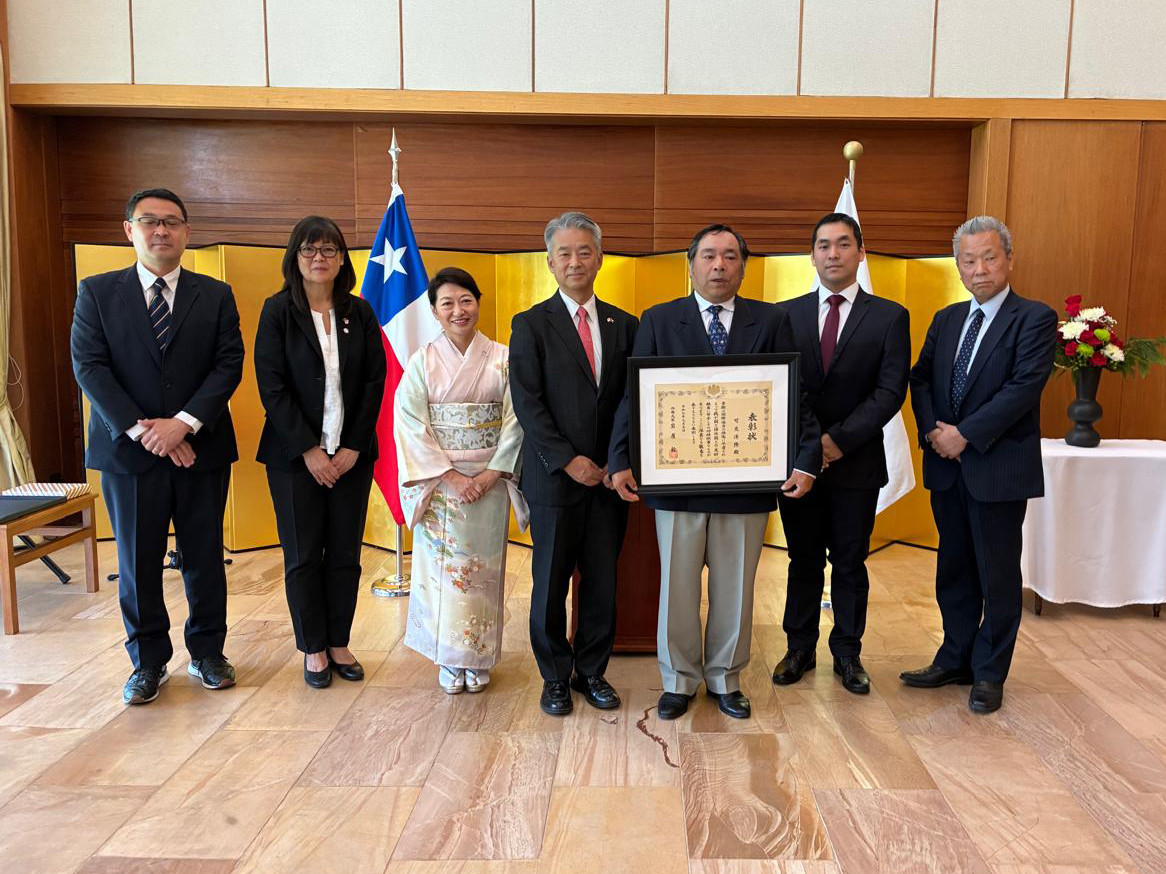
It is Japanese citizen Kiyotaka Kani, who is an expert in the production of seeds and cultivation of molluscs at the Chinquihue Foundation.
A ceremony at the Embassy of Japan in Chile honoured Kiyotaka Kani, who has devoted more than 40 years to shellfish production and aquaculture, mainly in Chile. He first arrived in the early eighties and now lives there.
The ceremony was headed by the Extraordinary and Plenipotentiary Ambassador of Japan in Chile, Sone Kenko, who was also joined by close family members of the awardee.
The distinction is signed by the then Japanese Minister of Foreign Affairs, Takeshi Iwaya. In it, it is indicated that Kiyotaka Kani has dedicated himself to promoting international cooperation, thus contributing to the establishment of friendship between Japan and other countries, and his achievements have been notable.
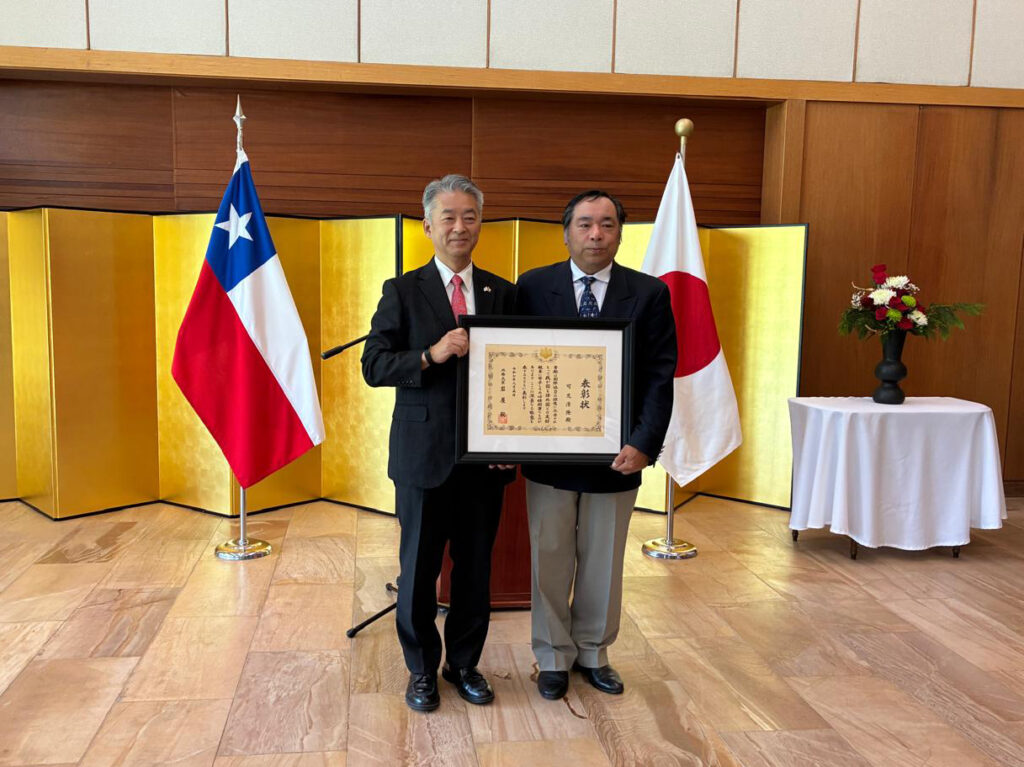
The recognition highlights the work of Kiyotaka Kani in our country in the dissemination of mollusk cultivation technologies and the development of the aquaculture industry in Chile.
Thanks to their work, techniques such as mussel and oyster farming have been consolidated throughout the territory, thus providing opportunities for local communities and symbolizing the cooperation between both nations.
Career
Kiyotaka Kani is a marine biologist from the National Fisheries University of Shimonoseki, where he studied between the years 1978 and 1982. Later he obtained a postgraduate degree in aquaculture at the same university.
In Chile, work began on the production of the northern oyster resource in Tongoy, Coquimbo region, between 1983 and 1985. After his time in the north of the country, Kiyotaka Kani arrived in Chiloé as an aquaculture expert in 1986. There, he dedicated three years of his life to the development of techniques for cultivating Chilean oyster and sea urchin.
From the early nineties he worked extensively in Japan and Morocco, before returning to Chile in 2000 to take charge of a project funded by the Japan International Cooperation Agency (JICA).
This project was aimed at giving the initial kick off of benthic resources aquaculture in Chile. Consequently, he developed the production of Japanese oyster seeds, North ostion, hedgehog and abalon, along with other Japanese professionals.
From 2004 he joined the team of Fundación Chinquihue in Puerto Montt, an opportunity in which he works in the Department of Marine Production.
He would then work in El Salvador, a country where he dedicated himself to the development of Japanese oyster and local clam production technologies.
Already in 2016 he worked in the area of Innovation and Development of Fundación Chinquihue, specifically in the technology transfer aimed at mussel producers in the Los Lagos region.
He later worked on the production of organic agar-agar with local alguero communities in Chiloé, as well as on value aggregation initiatives aimed at artisanal fishermen and small-scale aquaculture farmers in the Los Lagos region. He is currently working for Fundación Chinquihue in the production of Japanese oyster seeds, this in the context of the “Technology programme for sustainable development and scaling up of cultivation of Japanese oyster resource (Pacific oyster)” – the one financed by Corfo and led by the Catholic University of the North – which is aimed at consolidating the productive and commercial escalation of this quoted benthic resource in our country.