The research, whose results were presented in the context of Aquasur 2026, opens up new prospects for reducing the use of antibiotics in salmon farming and moving towards more sustainable aquaculture.
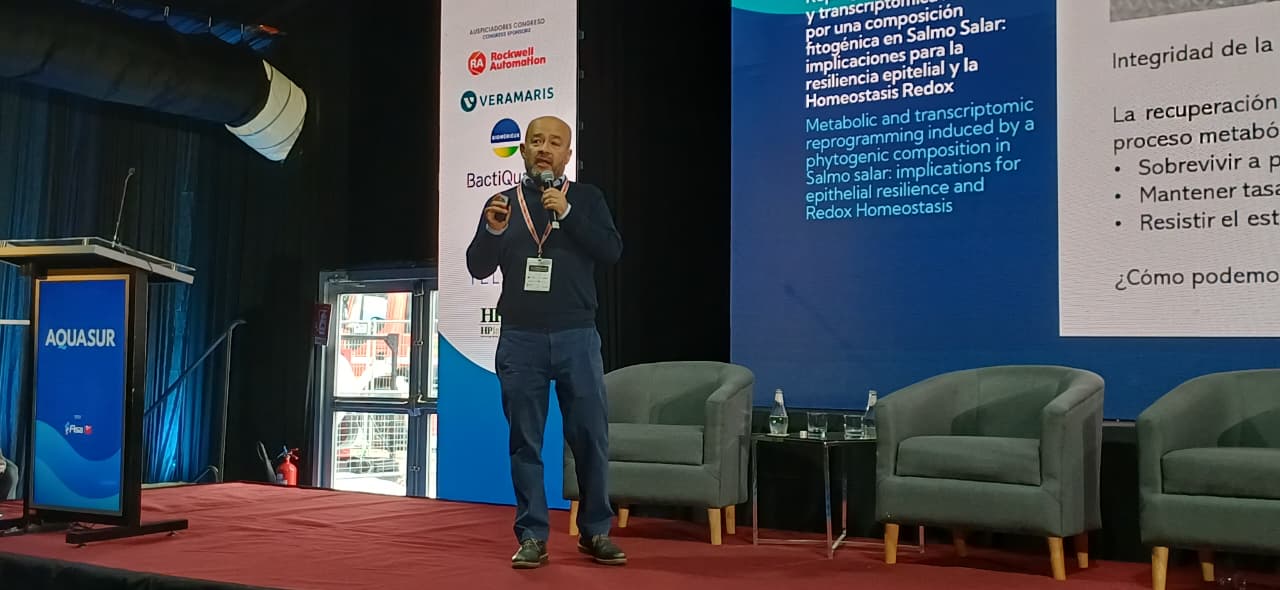
In its passage through Aquasur 2026, the Academic of the Universidad Austral de Chile (UACh) and Researcher of the INCAR² Centre Dr. Alex Romeropresented the results of the study “ Metabolic and transcriptional reprogramming induced by a phytogenic composition in Salmo salar: implications for epithelial resilience and redox homeostasis”.
This cutting-edge research topic in precision aquaculture is specifically focused on improving the health of Atlantic salmon (Salmo salar) through natural alternatives to traditional drugs. This is a collaborative work of the UACh, carried out in the salmon company MultiXin conjunction with the additive company HP Ingredients, Corp. USA, Feeding Latin America and the Laboratory of Immunometabolism of the Institute of Pharmacology and Morphophysiology of the Faculty of Veterinary Sciences.
In his speech at Aquasur, Dr. Romero exposed the use of the NatControl product, based on bioactive compounds extracted from the Andrographis paniculata plant, which are known in pharmacology for being potent anti-inflammatory and antioxidants, which in this context are used as a functional additive in the salmon diet. The study has been developed from in vitro standardization, using salmonid cell lines, to validation under productive conditions.
The fish test was carried out in the salmon company Multi X, in conjunction with the additive company HP Ingredients, Corp. USA, Feeding Latin America and the Immunometabolism Laboratory of the Institute of Pharmacology and Morphophysiology of the Faculty of Veterinary Sciences, led by Dr. Rafel Burgos, Dean of the Faculty. This laboratory has mass spectrometers oriented to metabolomic analysis, allowing study and characterize cellular mechanisms associated with pathological processes in salmonids, including infectious and non-infectious injury.
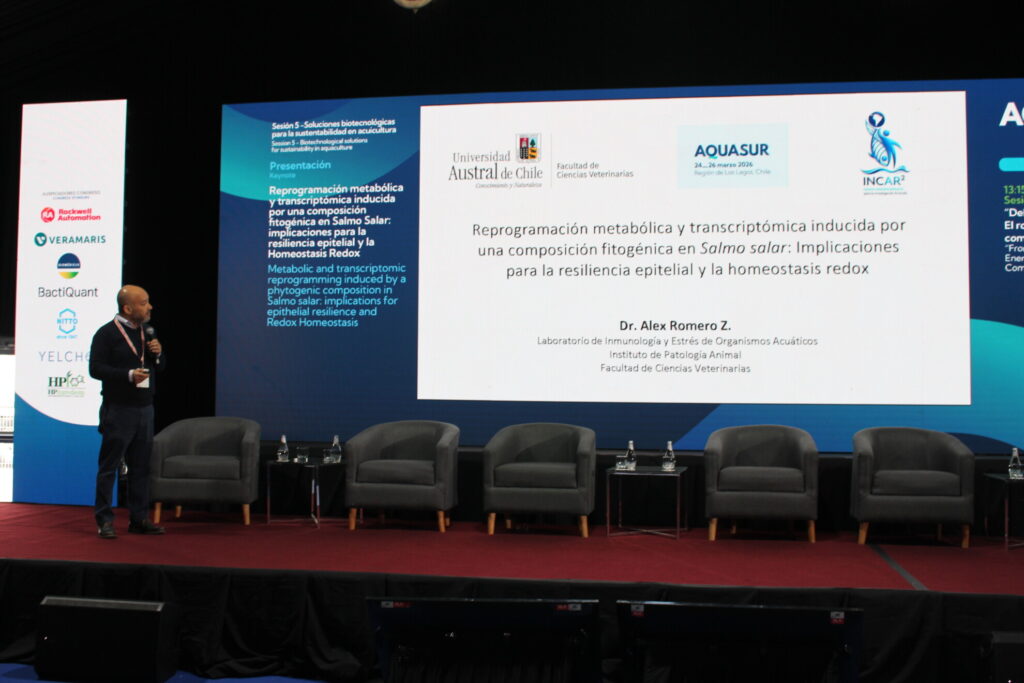
“At a productive level, the performance of a functional additive incorporated in fish food under productive conditions was evaluated for 60 days. The main results obtained show a distinctive “metabolic footprint” associated with a reconstruction of cell metabolism associated with key molecules found in plasma and salmon skin. In this sense, those associated with collagen structure stand out, strengthening of mucous membranes, metabolism of carbohydrates and fatty acids intended to obtain energy for tissue regeneration and growth,” commented Dr. Romero.
“The improvement of the metabolic status of fish through the use of functional additives is directly associated with the best functional performance of their organs and tissues, which positively impact on immune function and therefore on defensive mechanisms against bacterial and viral pathogens. This effect would be reflected mainly at the level of fish mucous membranes, the gateway to pathogens in salmon farming. For its part, Stressful stimuli by transport, temperature changes or productive management of fish, generate a imbalance of cellular redox homeostasis, so the addition of this type of products allows the fish to neutralize that cellular damage efficiently” emphasizes Dr. Romero, in charge of the laboratory of Immunology and Stress of Aquatic Organisms of the Institute of Animal Pathology of the UACh.
In conjunction with the UACh Immunometabolism Laboratory, it is expected to further deepen the multidimensional effects of this product at the metabolic level in vitro and in vivo. “In this sense, the multidisciplinary work between the company, producers and the academy is fundamental to the achievement of consistent results and that reflect reliably the performance of a functional product with technologies that allow to unravel the metabolic and physiological effects in fish. Specifically, it is expected to continue to analyze its effect on mucous membranes such as gill, intestinal and skin, compared to environmental and pathogenic variables associated with the sanitary status and productive parameters of salmonid fish,” concluded INCAR² researcher.