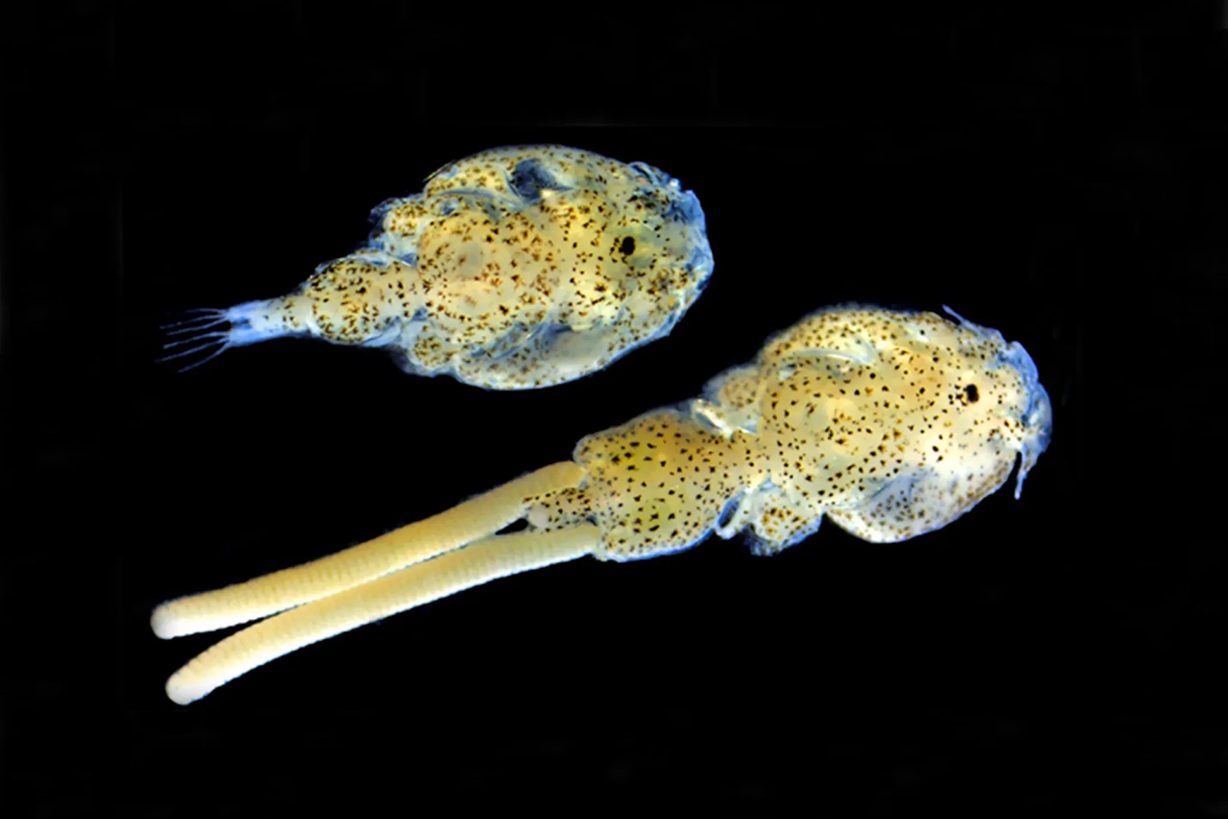
The collaboration brings together the capabilities of Chile, Norway, United Kingdom and Canada to advance towards more sustainable strategies for controlling the main ectoparasite of salmon farming.
The Interdisciplinary Center for Aquaculture Research - Applied Research, INCAR² which is led by the University of Concepción, has joined the international consortium CrispResist strengthening scientific collaboration between Chile, Norway, United Kingdom and Canada to better understand the genetic mechanisms that determine salmon's resistance to sea lice and accelerate the development of new strategies for control of this parasite.
The incorporation of INCAR² to CrispResist – Harnessing cross-species variation in sea lice resistance (Taking advantage of the interspecific variation in resistance to sea lice) represents an important step in connecting research on the two main species of sea lice affecting salmon farming: Lepeophtheirus salmonis in the northern hemisphere and Caligus rogercresseyi in Chile.
The project, funded by the Norwegian Seafood Research Fund (FHF) and coordinated by Nofima, brings together researchers from the Institute of Marine Research (IMR) of Norway, the Roslin Institute of the University of Edinburgh, the University of Bergen, Fast Fish Inc./University of Prince Edward Island of Canada and, now, INCAR² in Chile.
From biology compared to functional genomics
CrispResist seeks to understand why some species of salmonids present a considerably greater resistance to sea lice than Atlantic salmon, and to translate these biological differences into potential solutions for salmon farming.
The consortium has already identified differences in the expression of genes and proteins between susceptible salmonids, including Atlantic salmon, and more resistant species, such as the Coho Salmon and the Pink Salmon. The research has also characterized parasite proteins capable of suppressing salmon's immune response and has identified potential chemical signals involved in host-parasite interactions.
A particularly innovative component of CrispResist is the use of CRISPR-based gene editing as a functional genomic tool, in order to assess whether the candidate genes identified by comparative analyses contribute effectively to sea lice resistance.
This approach could generate biological knowledge applicable to various future control strategies, including genetic selection, vaccines, functional additives for food and, depending on regulatory and social acceptance, genetically edited salmon with greater resistance to sea lice.
INCAR² incorporates the Chilean model of Caligus into the consortium
The incorporation of INCAR² provides a complementary biological system to CrispResist, based on extensive research experience on Caligus rogercresseyi, the main ectoparasite affecting Chilean salmon farming.
For more than a decade, INCAR² has integrated genomics, transcriptomics, the biology of host-parasite interaction, epidemiology and oceanography to understand C. rogercresseyi and its interaction with salmon. This work has contributed to the identification of molecular mechanisms associated with the development of the parasite, its adherence to the host, its reproduction and its response to antiparasitic treatments, as well as the development of molecular surveillance tools and alternative control strategies.
As part of this collaboration, INCAR² will provide biological knowledge and genomic information corresponding to different stages of development. C. rogercresseyialong with a new version of its genome at chromosomal level and resolved in haplotypes. The Centre will also provide genomic data from resistant and susceptible Atlantic salmon families, challenged with C. rogercresseyi, in addition to information on the reguloma and methyloma of host-parasite interaction, validated protocols for parasite cultivation and experimental challenges in salmon, as well as prototypes of vaccines against sea lice.
A particularly relevant aspect of this collaboration will be the possibility of evaluating, in the Chilean system of C. rogercresseyi — Atlantic salmon, candidate mechanisms identified by the international consortium.
INCAR2 has an experimental infrastructure at the University of Concepción that allows to carry out challenging studies controlled with the parasite. The consortium agreement specifically identifies the opportunity to evaluate CRISPR candidates developed by CrispResist in Atlantic salmon challenged with C. rogercresseyi.
An international dimension for marine lice resistance research
Stop Nicholas Robinson, Project Manager of CrispResist in Nofima, the incorporation of INCAR² brings an important comparative dimension to the project:
“We are very happy to welcome INCAR² to the CrispResist consortium. His extensive experience in Caligus rogercresseyi, together with the genomic resources and experimental capabilities developed in Chile, offers a unique opportunity to expand the knowledge generated by CrispResist to another important system between sea lice and salmon. By bringing together the experience of Norway, Chile, the United Kingdom and Canada, we will be able to investigate whether some of the biological mechanisms associated with sea lice resistance are conserved among different species of sea lice. salmon and parasites”.
Robinson also stressed that this collaboration could strengthen the transfer of advances in functional genomics to solutions relevant to salmon farming:
“One of CrispResist’s central objectives is to advance from the identification of genes associated with resistance to the experimental demonstration of their function. The participation of INCAR² gives us the opportunity to evaluate some of these candidate mechanisms in Atlantic salmon challenged with C. rogercresseyi. This comparative approach can help us identify robust biological pathways that could ultimately contribute to genetic improvement, vaccines, functional foods or other strategies aimed at reducing the impact of sea lice on salmon farming.”
Connecting two of the world's leading salmon producing regions
According to Cristian Gallardo-Escárate, director of INCAR², this collaboration offers an opportunity to advance from the descriptive genomics towards the functional validation of the mechanisms that determine the resistance to sea lice.
“The incorporation of INCAR² to CrispResist allows us to connect the extensive knowledge generated in Chile about Caligus rogercresseyi with border research on salmon resistance and internationally developed functional genomics. One of the most interesting aspects is the possibility of determining whether the resistance mechanisms identified in other marine salmon-pijo systems are preserved and can be transferred to biological reality of Chilean salmon farming.”
Gallardo-Escarate added that collaboration also reflects the growing importance of integrating genomics with experimental biology.
“Genomics has allowed us to identify numerous candidate genes and biological pathways associated with resistance, but the next challenge is to demonstrate their biological function. The combination of comparative genomics, epigenomics, CRISPR-based functional validation and parasite-controlled challenges can significantly accelerate the identification of mechanisms that could translate into practical solutions for industry.”
Towards more sustainable control of sea lice
Sea lice remain one of the main biological and economic challenges for global salmon farming. Current control strategies require combinations of pharmacological and non-pharmacological interventions, making the development of preventive approaches based on biological mechanisms increasingly important.
The CrispResist consortium seeks to generate knowledge that supports future genetic solutions aimed at reducing dependence on antiparasitic treatments. The project considers potential applications ranging from genetic selection and functional food additives to vaccines and gene editing strategies.
For INCAR², joining the consortium also represents an opportunity to position Chilean research and C. rogercresseyi's model in an international comparative framework.
The incorporation of INCAR² to CrispResist occurs at a particularly relevant time for Chile, where the gene edition applied to aquaculture begins to occupy a growing place in the scientific, productive and regulatory discussion.
Recently, the Undersecretary for Fisheries and Aquaculture (Subpesca) organized the webinar “Génic Edition Regulation: International Experiences and Challenges for Chile”. The meeting brought together national and international regulatory experiences and addressed both the new gene editing tools and their opportunities for aquaculture and the regulatory challenges associated with their research and eventual application in hydrobiological species in Chile.
During the webinar, potential applications of gene editing were analyzed, particularly relevant for salmon farming, including the generation of sterile fish, the increase in resistance to diseases such as SRS and the development of new strategies to confront sea lice.
In the latter area, CrispResist was presented as an example of international research aimed at understanding the biological mechanisms that explain the differences in sea lice resistance between species of salmon from the Pacific and the Atlantic, and to assess, through CRISPR-Cas9, whether such mechanisms can be functionally transferred. In addition, during the discussion it was suggested that part of this knowledge could be evaluated in relationship with the species of sea lice present in Chile.
From a regulatory perspective, webinar also showed that Chile is beginning to build the necessary conditions to develop this type of research. Sub-fishing noted that there is currently no specific legal definition for genetically edited organisms and that the use of a gene editing technique alone does not determine that the resulting organism should be considered a genetically modified organism (GMO). At the same time, the authority is evaluating a request to use gene editing in a limited scientific study, considering initially progressing through case-by-case authorizations, as well as risk analysis and the development of a technical guide for future initiatives.
In this context, the incorporation of INCAR² into the CrispResist consortium takes on a strategic dimension. The collaboration will allow linking international advances in functional genomics and gene editing with existing scientific and experimental capabilities in Chile and, in particular, explore whether the mechanisms of resistance identified against Lepeophtheirus salmonis can be evaluated in the Caligus rogercresseyi–salmon system of Atlantic. In this way, CrispResist can contribute not only to generating new scientific knowledge, but also to providing relevant experimental evidence for the discussion on the responsible development of gene editing in Chilean aquaculture.