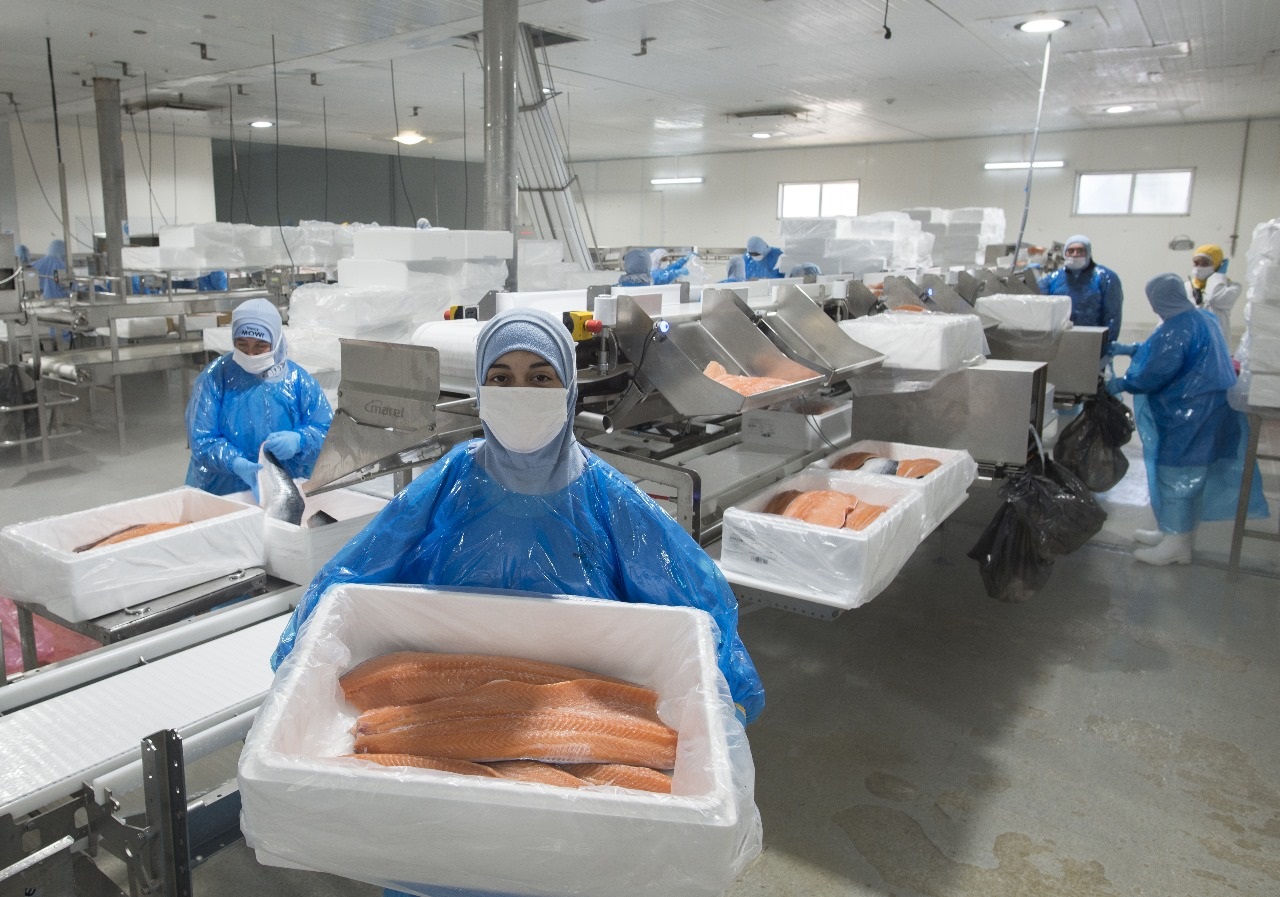
"Map of trust in Chile's export industries" highlights the performance of the salmon farming industry in economic, environmental and social aspects, showing the growth that the sector has experienced in recent years and the positioning of Chile as the second exporter worldwide.
The salmon farming industry obtained a prominent role in the latest version of Map of trust in Chile's export industries, a quantitative study that analyzes the impact that the performance of industries relevant to the country's economic development has on public opinion.
The report, carried out by Criterios together with the Adolfo Ibáñez University (UAI) and Social Management, evidence the important growth that salmon farming has had this year compared to the previous period.
One result that stands out positively is the assessment that people give to the national economic contribution that this industry makes, since 40% of the respondents put it note between 6 and 7, growing by 8 percentage points compared to the measurement of the previous year (32%). With these notes of excellence, salmon farming is positioned as the fourth best evaluated sector after copper, lithium and fruit industry.
A similar perception is seen in the regional and local contribution, where salmon farming grows this year from 31% to 33%, while in innovation of production processes it increases from 28% to 31%.
Environmental and social impact
Regarding environmental performance, citizens positively evaluate the efforts made by salmon farming in recent years, with 23% of respondents rating the sector 6 or 7 in the responsible use of water. This represents an increase from 20% in the previous year, placing salmon farming on the forest industry (20 per cent) and lithium (19 per cent). In addition, in the proper management of polluting wastes, is the second best evaluated industry with 21.5 per cent, only below fruit production (26.6 per cent)
The assessment also looked at social factors. Salmon farming stood out on 2 measures important to its development. The first was access to quality employment for women: 27% awarded the sector scores of 6 or 7, placing it second for decent work opportunities for women, ahead of copper (25%), lithium (19%) and forestry (17%). The other key measure, The relationship with the local communities reaches 26.7% of marks of excellence, only exceeded the fruit-growing (34%) and copper (31%).
Finally, in relation to confidence levels, salmon farming is ranked fourth this year with 19%, after the fruit sector (33%), copper (32%) and lithium (20%).
Regional impact
An important factor to be highlighted in the study is the assessment obtained by salmon farming in regions versus the capital. In the ‘host areas’ of the sector (Los Lagos, Aysén and Magellan), 28% say they have “many confidence”, versus 20% in the RM. Something similar occurs with the perception of contribution to the regional economy, with 42 per cent qualifying it with 6 or 7 in regions, above the 36 per cent recorded in the metropolitan area.
The image of salmon farming as an exporting industry also presents highlights. Although Chile is currently the second largest salmon producer in the world, only 20% of respondents consider this to be the case. However, 81% think that Chile occupies an important position as an international salmon exporter and 15% believe that demand for this product will increase in the next 10 and 20 years.
“Salmon is a product that as Chileans we have to be proud of, today it is a challenge to make more and more people know that this Chilean product is present in more than one hundred relevant international markets such as the United States, Japan and Brazil, representing our country through different formats and added services. We are talking about a product of great quality, versatility and also capable of adapt to different logistics marketing solutions such as sea, air and land transport. As if that were not enough, salmon is one of the most sustainable animal proteins, because it has the lowest carbon footprint, it is the one that requires the least use of fresh water to be produced and has the best conversion factors (relationship between the amount of food it receives and the amount it absorbs and transforms it into edible), among others. For all these elements the Chilean salmon industry offers a tremendous opportunity for positioning and sustainable development for our country and that we cannot miss. We have a duty to take over and project their future sustainable development,” said Loreto Seguel, Executive Director of the Salmon Council.
The “Map of Trust in Chilean Exporting Industries” consisted of a quantitative study through surveys conducted between September and October 2024. To this end, a sample of about 2,000 men and women aged 18 and over, residents of the whole country and belonging to all socio-economic levels, was interviewed.