The initiative aims to bring together the research capabilities of the institution in matters related to the sea, from various disciplines, positioning it as a reference role at a national and global level.
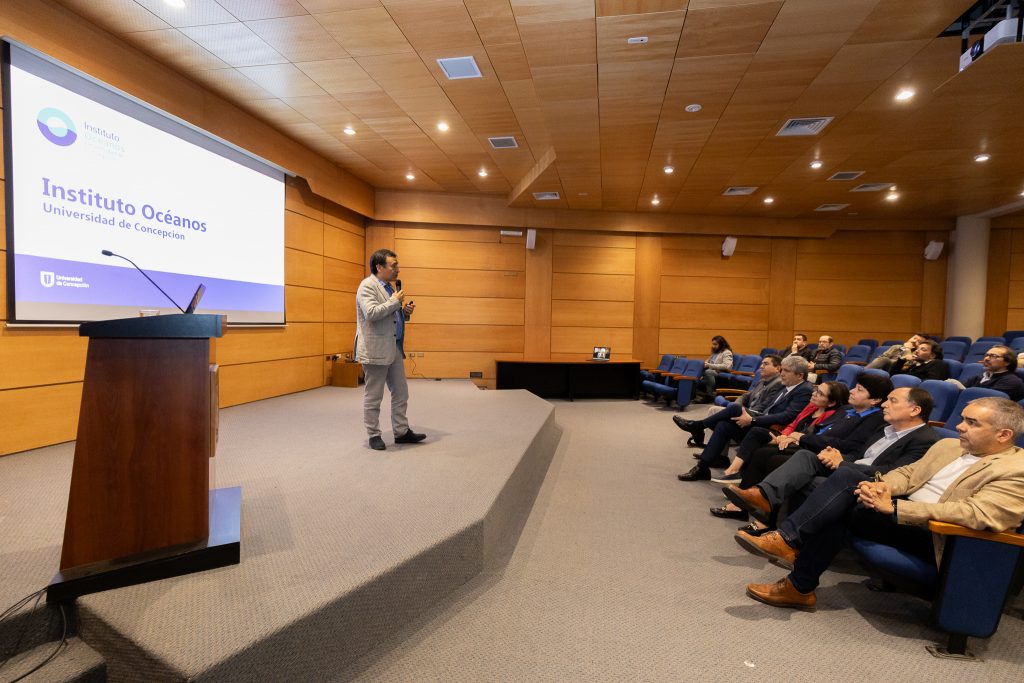
On Wednesday 4 December, in a ceremony headed by the Rector Dr Carlos Saavedra Rubilar and with the participation of deans, professors, directors and directors of centers, among other authorities, the University of Concepción (UdeC) presented the 'Ocean Institute' to the community.
Building on a broad tradition in marine sciences, this new initiative aims to promote inter and multidisciplinary collaboration in the study of the functioning and sustainability of the oceans for the well-being of the country and the planet, strengthening the role of UdeC as a world reference in this area.
"Our University has a great tradition in this subject and also a responsibility to address the challenges from different areas," highlighted Rector Saavedra at the presentation ceremony and exemplified with the work that scientists from the Millennium Institute of Oceanography, IMO-Chile, the Center for Oceanographic Research in the South-Eastern Pacific COPAS Coastal, the Fondap INCAR Center and the Center are currently promoting. Oceanographic Instrumentation (CIO)
In this context, the Rector Saavedra pointed out that there are "opportunities that are identified in this area, such as the role that our country could play internationally within the framework of the High Seas Treaty (BBNJ, Biodiversity beyond National Jurisdiction)” and the role that the ocean can play in the complicated economic context that crosses the Biobío region.
On the occasion, the highest university authority thanked the researchers and researchers who participated in the design of the new institute and highlighted the generosity of the members of the scientific committee, as well as announcing that the direction of this stage of installation lies in the Dr. Osvaldo Ulloa Quijada, also Director of IMO-Chile.
It was precisely Dr. Osvaldo Ulloa, who presented the details of this new institutional initiative, a time when “indeed, for the institution it is a milestone, because we have been working for several years to try to bring together the capacities that we have within the University of Concepción, through the different academic units and the advanced research centers, in an umbrella that allows us to face the national and, above all, international challenges.”
“We have received the cross-cutting support of the different faculties, the administration of the University and our colleagues,” Dr. Ulloa and anticipated that “this will put us on a new footing in the sciences of the sea and in the ocean issue, which is much broader, not only in the part, let’s say scientific, but in everything that implies an oceanic Chile and a maritime Chile”.
Meanwhile, the Vice-Rector for Research and Development Dr. Andrea Rodríguez Tastetets said that “the University has to position itself in the areas of national interest.”
“Universities must make strategic decisions to empower themselves in differentiating areas at the national level, considering a highly competitive system like ours,” Dr. Rodriguez. At the same time, he noted that the University of Concepción made a decision in applying to the Structural Funds for Border Research (FIU-F), also taking as missionary pillars a first axis in ocean sustainability and a second axis in sustainable productive processes: “This means that, during this coming year, we will have to work collectively on a development plan that will make us reflect on how we dream the University in these thematic areas over the next ten years.”
The initiative was also held by researchers, researchers and authorities attending the ceremony as the Dean of the Faculty of Natural and Oceanographic Sciences Dr. Margarita Marchant San Martín, who commented that his academic unit “has been leading the areas of oceanography. Sea sciences, marine biology, ecology and this with the Oceans Institute will be an even greater challenge, as we would have to somehow place a totem in relation to these lines and areas of ocean knowledge.”
The Dean stressed that the project “not only points to these areas, but also to other areas such as social, legal and humanities-related areas, from a social and sustainability point of view. From that point of view, there are many challenges in which this institute could somehow address itself.”