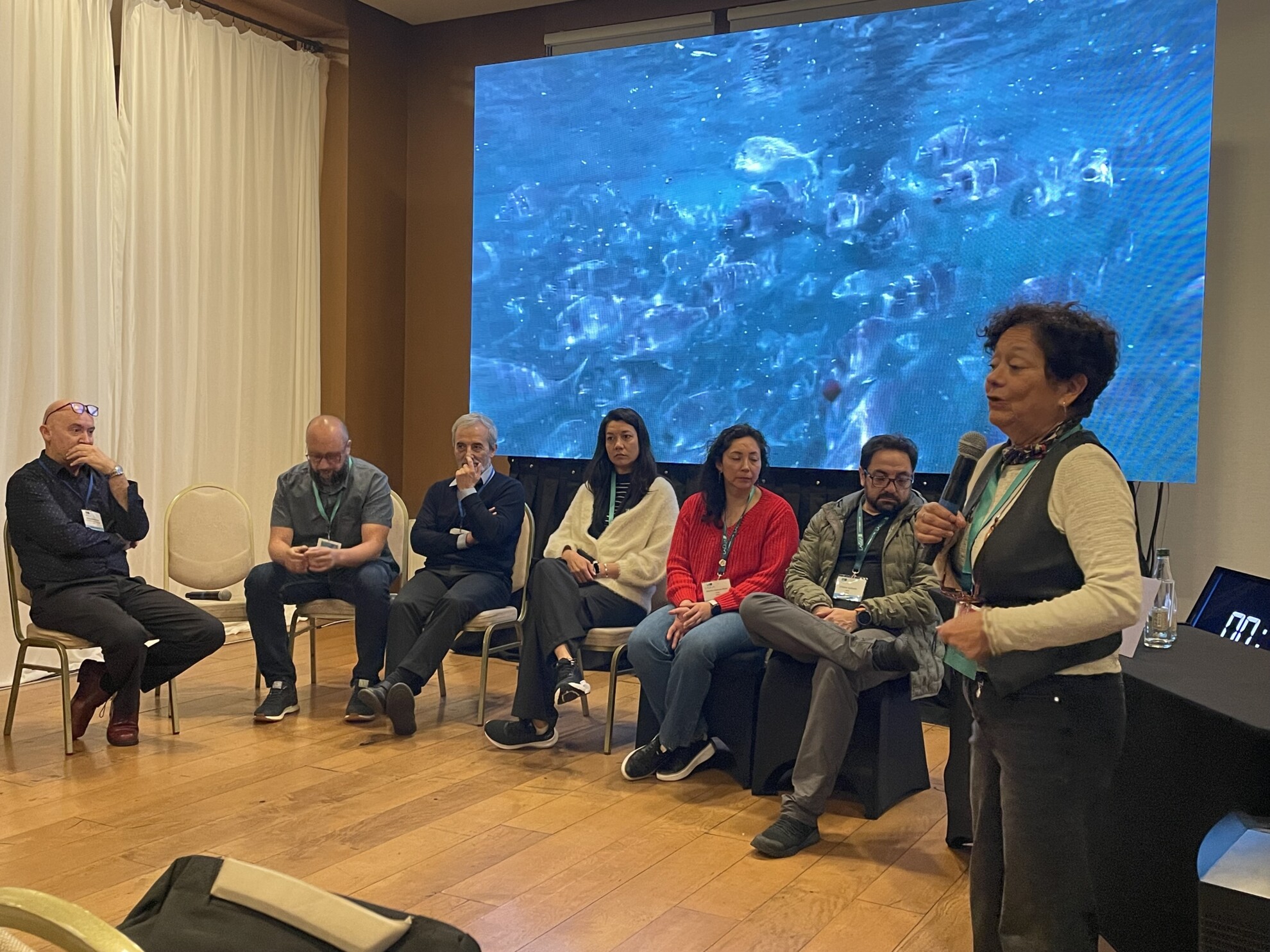
National and international researchers met in Puerto Varas to address the challenges of aquaculture from multiple disciplines, highlighting advances in genetics, environmental modeling, ecosystem management and public policies.
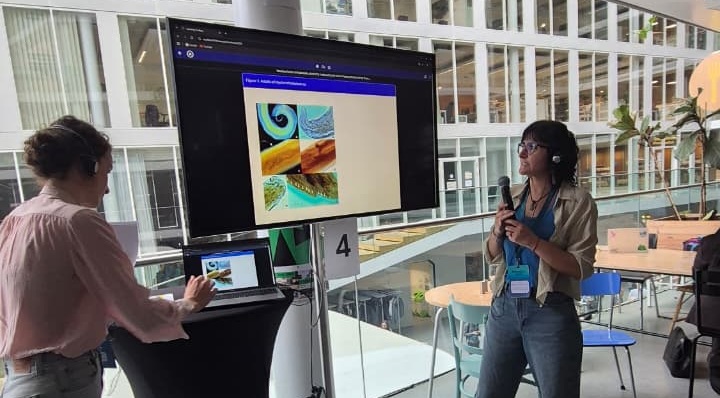
During the LAQCUA Congress, held last week in Puerto Varas, the Interdisciplinary Center for Aquaculture Research of the University of ConcepciónIncar UdeC brought together researchers from Chile and abroad in a symposium that highlighted interdisciplinarity as a key tool for solving complex current and future aquaculture problems.
The event which had a large audience began with the intervention of the Principal Researcher of Incar, Dr Doris Soto Benavides, who raised some of the differences between multidisciplinary and interdisciplinary science, highlighting the challenges and goals of the latter, and how it facilitates decision-making in the management of the sector with productive, environmental and social implications.
Incar Aquaculture Symposium: effective policies and management strategies
The presentation round of the Incar symposium began with the Researcher from Embrapa Brazil, Dr. Janaina Mitzue, setting out some of the challenges and goals of this institution in collaboration with research centres and the private sector to promote and address research for the sustainability of aquaculture in that country from different perspectives, promoting, for example, integrated multitrophic aquaculture and the integration of the aquaculture and agricultural sectors, in a joint effort to move towards the objectives of sustainable development.
This presentation made it possible to highlight the efforts of the state as an actor and manager of interdisciplinary research and technological development in the food sector.
Next, the challenges of research to address the effects of salmon lice (Caligus rogercresseyi) from molecular biology were presented with the innovative development of reverse calf disease presented by the Research Associate of Incar, Dr. Valentina Valenzuela-Muñoz; Then the Deputy Investigator of the Center, Dr. Rodrigo Montes, exhibited advances in the development of mathematical models capable of revealing and quantifying the complex interaction between oceanography and the dynamics of the densities of cultivation that cause the marked outbreaks of Caligus in areas of the inland sea of Chiloé (ACS 10A, ACS 10B), and that have also allowed the development of early warning indicators that can be used as tools for aquaculture management.
Finally, the Principal Investigator of Incar, Dr. Jorge Dresdner Cid, addressed the unit costs of production associated with Caligus, highlighting that there is a compensation between improvements in biomass and treatment costs resulting in non-significant effects to unit costs.
The Academic, highlighted how these investigations complement each other, from different perspectives, and how they contribute to the design of management measures and policies to address this parasitism in a more integral way, and how research is moving from disciplining to interdiscipline progressively generating a common language.
Promoting more sustainable and resilient aquaculture
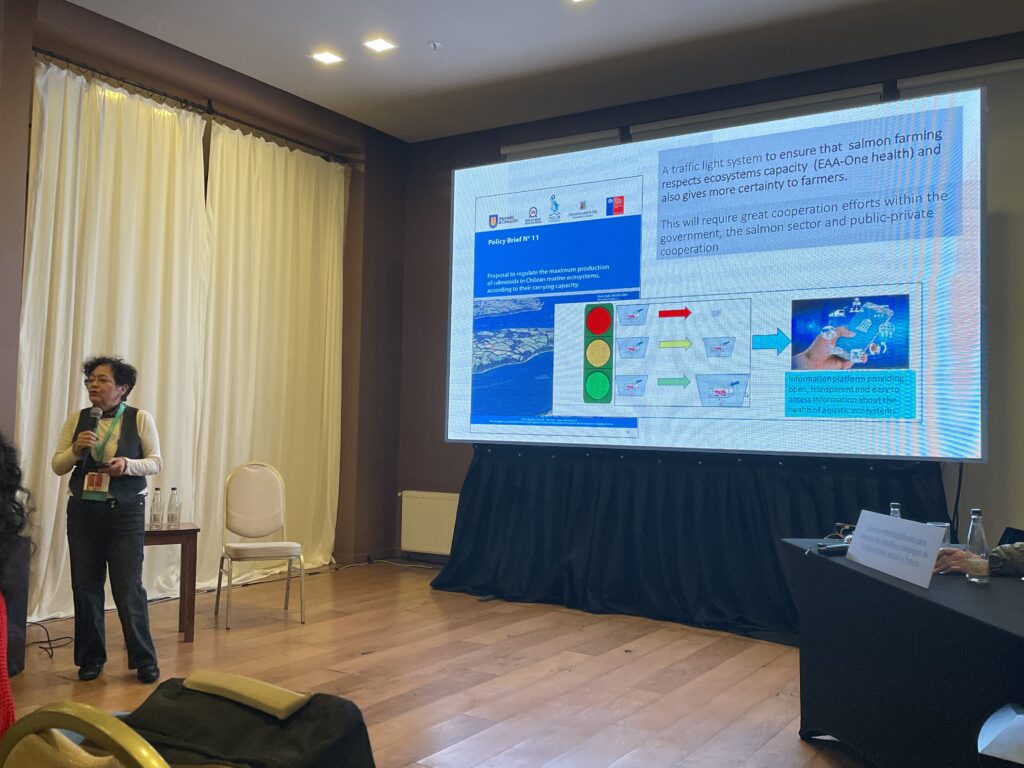
Presentations of the Incar Symposium on Aquaculture continued with Dr. Doris Soto describes the process to develop a traffic light system that regulates salmon production according to the load capacity of ecosystems and based on a model that connects environmental risks with productive risks, thus generating a management framework oriented by the ecosystem approach and One Health.
The model and comparative risks also allow modeling risk reduction by modifying the components of risk; cumulative production, use of antimicrobials and pesticides.
Dr. Soto stressed the need for reconsider the spatial distribution of the sector with the possibility of relocation to minimize risks and increase opportunities and proposed some priority actions for public policies.
Meanwhile, the presentation of the Deputy Director of the Incar Center, Dr. Cristian Gallardo-escarate, focused on the opportunities generated by decoding the genome of Mytilus chilensis, also known as “chorito” or Chilean mussel, has allowed from interdiscipline to understand particular aspects of its biology and how it adapts to the environment.
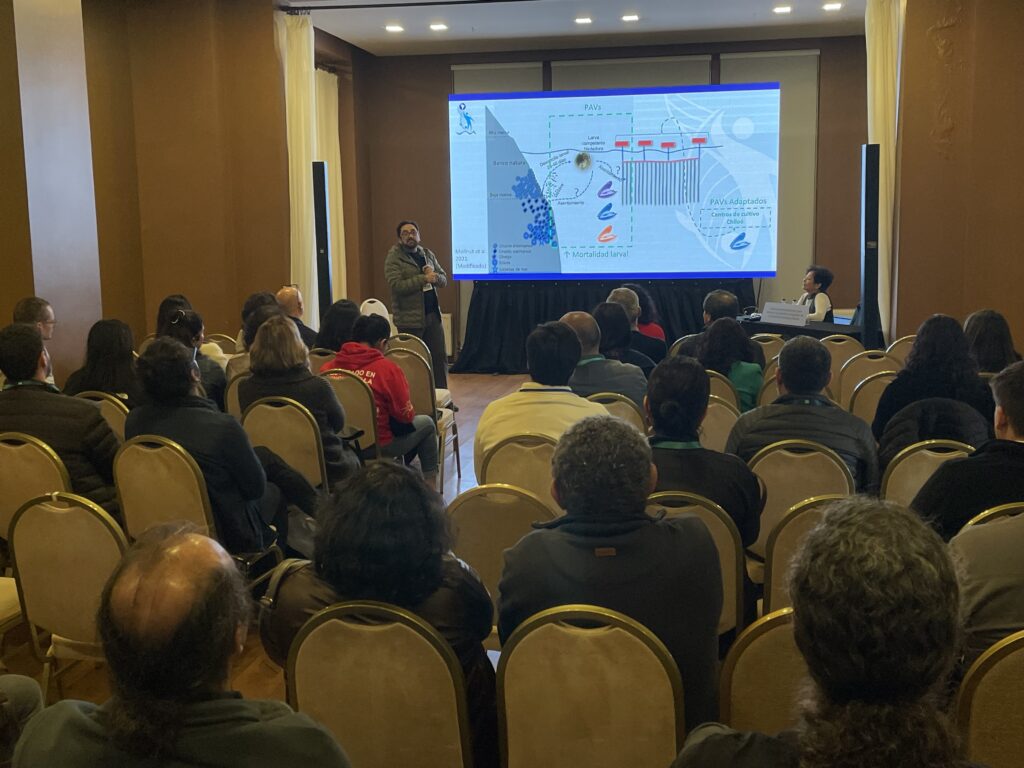
"The understanding of larval production processes, as well as environmental and oceanographic variability, suggests that the adaptive capacity of this mussel is based on unique molecular mechanisms such as the presence-absence gene variation phenomenon (PAV). In this way, it is estimated that the mussel pangenome contains approximately 24% of dispensable genes, whose configuration at the individual level allows rapid adaptation to different environments. This knowledge supports a program of management of mussel banks that provide larvae for aquaculture in southern Chile, such as to ensure greater resilience and sustainability in the long term," added Dr. Gallardo-Escape.
Impact of climate change
The final presentation of the aquaculture symposium organized by Incar was by the Associate Researcher of the Center Dr. Jorge León-Muñozwho highlighted the dependence of aquaculture in southern Chile on the natural regime of rivers that support phases of freshwater cultivation (piscicultures) and influence coastal marine areas where seed collection processes are developed, as well as the fattening of salmon and mussels.
"This connection has been altered by climate change and landscape transformations, an alteration evidenced by hydrological and oceanographic information, based on monitoring, remote sensors and modelling, which show how variations in flow rates already affect cultivation conditions in rivers and fjords. Such changes require mitigation and adaptation measures, where watershed conservation and management result key to maintaining the resilience and future viability of aquaculture in a changing climate", stressed the researcher.
Strengthening collaboration
The event ended with a panel where the public was able to dialogue with the exhibitors, with comments and recommendations emerging especially for the public and private sectors in order to support and promote interdisciplinary research.
It was considered particularly relevant to support the translation of these efforts into more dynamic and flexible regulations and policies that can implement such advances considering the complexity of natural and social systems, and climate change. This is also relevant for the private sector to be able to incorporate such scientific advances and was seen as particularly necessary to improve interaction and coordination among various stakeholders. State institutions and public-private partnerships.
The group of Incar researchers who participated in the Aquaculture Symposium valued the audience's appreciation and response to the presentations and final discussion and reiterated the center's commitment to advancing interdisciplinary research of the best quality to generate innovation and contribute to the development of sustainable aquaculture in Chile and globally.
At the annual meeting of the Latin American and Caribbean Chapter of the WAS (World Aquaculture Society) held in Puerto Varas, Chile, the Incar Center had a large representation with 9 oral presentations and 14 presentations in posters.