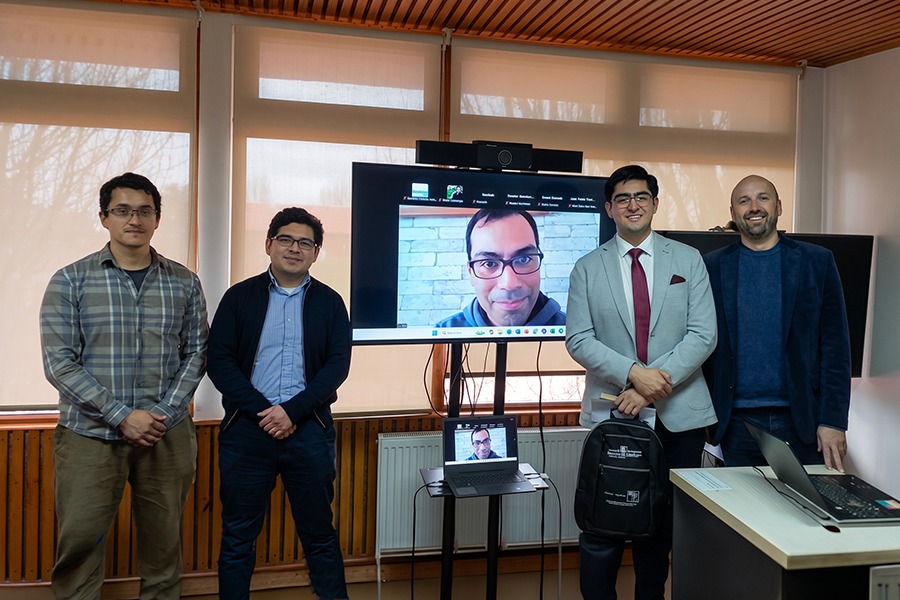
The meeting brought together researchers and researchers related to the study of invasive species in marine, freshwater and terrestrial environments.
The Dr. Sara M. Rodríguez, academic of the Faculty of Sciences from the Catholic University of the Holy Concepción (UCSC), participated in XIII International Conference on Biological Invasions. The event took place in Portugal, organized by the University of Lisbon and the University of Évora.
Dr. Rodríguez presented in format poster the scope of its research related to the Chinook salmon (Chinook salmon), invasive species which was introduced to Chile in the late ’70s and now lives and spreads freely in the wild. The research involved studying approximately 120 samples from stomachs and intestines of Chinook salmon, from Caleta La Barra, in the commune of Toltén, province of Cautín, region of La Araucania.
"We made the first description in Chile of Enteroparasitic fauna of these fish, with the aim of determining what they are feeding, using the parasites as indicators. Besides, if this salmon is already a suitable host for native parasites to develop in a definitive state in him," explained the academic.
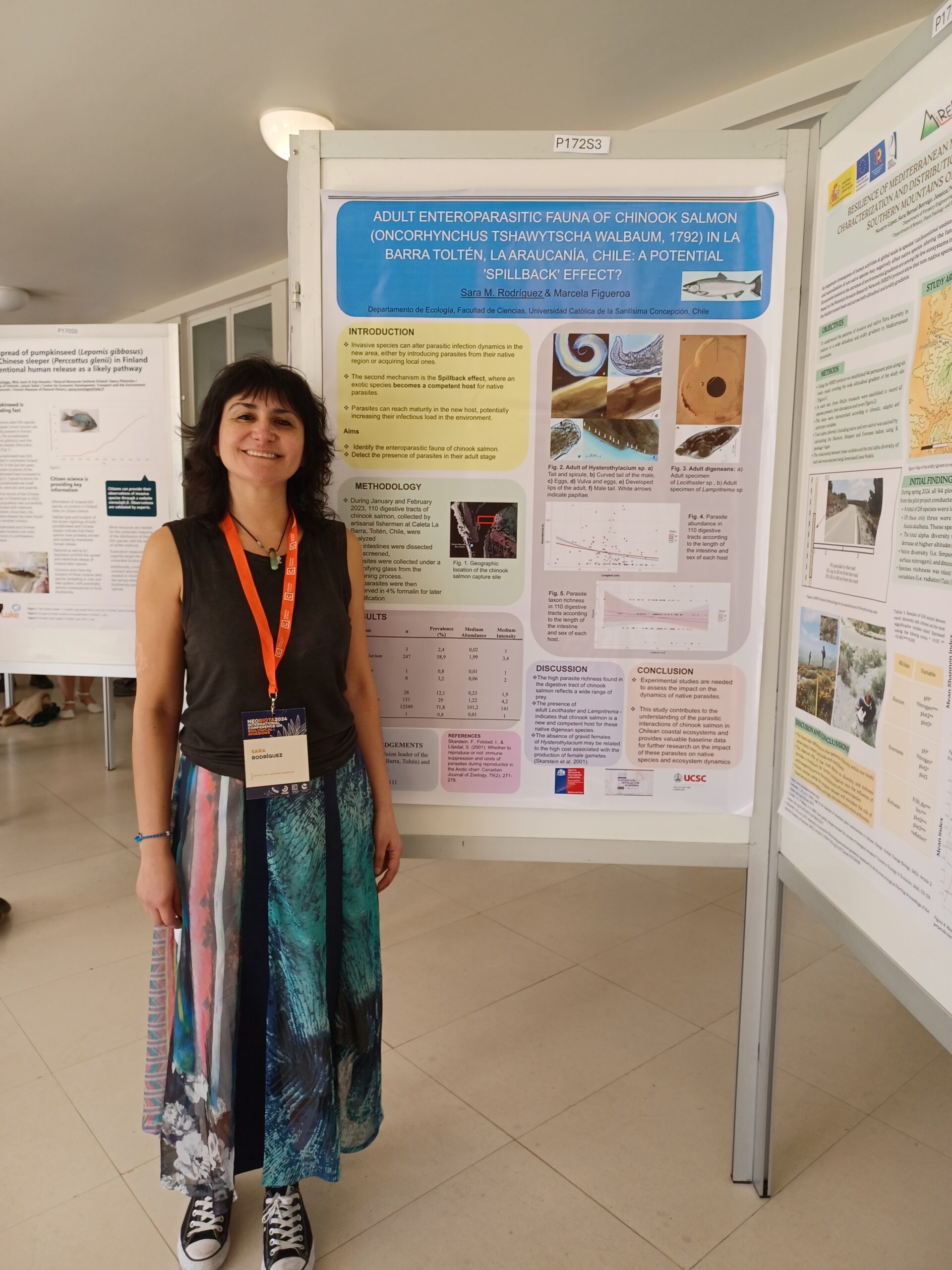
The study sought to identify whether this salmon releases eggs from adult parasites into the environment. As this phenomenon occurs, Chinook salmon is understood to be a introduced speciesThis environment was used to, and parasites from the Pacific native environment also became familiar with all their physiology, identifying it as a suitable host.
Study details
They were detected around nine parasitic taxasof which six of these were found larval in the species. In addition, three of these taxa were identified as adult parasites in intestine Chinook salmon.
"On the one hand, this salmon is being a new host for three parasites that develop in native fishBut now they found Chinook salmon the right characteristics to develop. Along with this, the other nine larvae of parasites found realize that salmon is being intermediate host of these parasites, i.e. it houses them. From an ecological point of view, it is becoming a new node within a food chain," added Dr. Rodriguez.
Thus, this salmon becomes a prey for different condrichts, sharks, rays and sea lions, which are the Definitive hosts of these species that live as larvae on Chinook salmon.
The study tested the hypothesis called "Spillback Effect", related to biological invasionswhere a host arrives in an introduced area and is capable of harboring native parasites.
Regarding the importance of research, the academic emphasized that Chile has become one of the countries with the highest salmonid production. "While this species is not cultivated, Intentionally. were released into the natural environment and these animals found the necessary conditions for their development. They're voracious predatorshaving a direct effect on the consumption of dams native to the environment", he stressed.
Finally, the instance served to generate contacts with scientists and scientists related to studies in parasitologyfrom France, the United States and Spain. "They are working with similar introduced species, with fish that have been introduced into Europe and the United States, and that have exercised some local impact in those environments," he said.
*Photo credits: courtesy of the Faculty of Sciences of the UCSC.