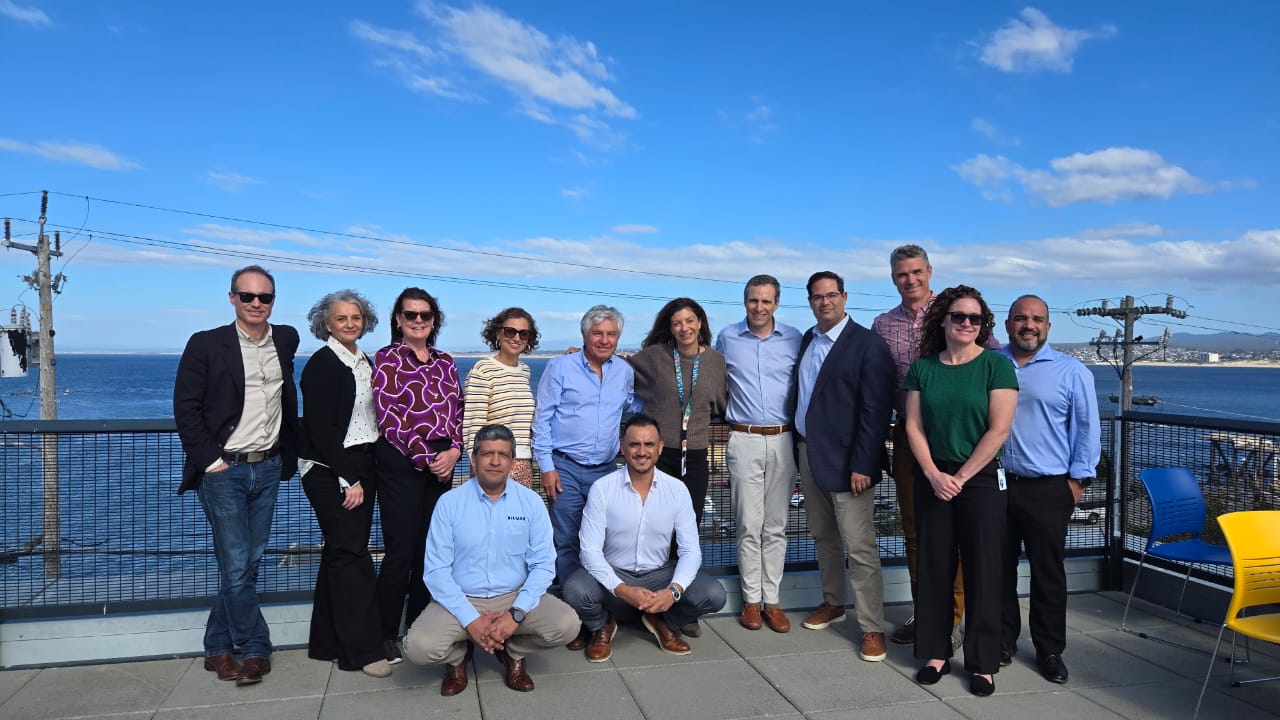
Prominent representatives of Chilean salmon farming visited California to assess progress in reducing antibiotic use and strengthen links with international buyers, as part of a six-year alliance for sustainability.
Last week, a delegation from SalmonChile and representatives of the national aquaculture sector visited the Monterey Bay Aquarium in California, United States, to launch a new phase of work in the joint program for the reduction of antibiotic use in Chilean salmon farming, an initiative that has completed six years of continuous collaboration and has positioned Chile as a reference in transparency and sustainability.
The Monterey Bay Aquarium is a non-profit organization dedicated to education, research and ocean conservation. Its mission is to inspire marine conservation through living exhibits, educational programs and scientific projects that promote a sustainable relationship with ocean ecosystems. In addition, it collaborates with academic institutions, governments and other organizations to promote public policies that protect the marine life, promote responsible fishing and reduce ocean pollution.
In this context, the Chilean salmon farming sector has achieved significant advances in sustainability thanks to initiatives such as the strategic alliance with the Monterey Bay Aquarium. Chile stands out internationally for its transparency in the use of antimicrobials in aquaculture, with public and disaggregated data by company. In recent years, significant advances have been made in responsible use thanks to different public-private initiatives with a focus on prevention, vaccination and good health management practices.
It was a very valuable opportunity to bring to the table the evidence, the lessons and challenges. We shared information with total transparency, something essential when the focus is on sustainability and the future outlook of a strategic industry for the country. We were able to open new lines of work and strengthen the link with key actors from the environmental world and the international market, who value knowing directly from the source the efforts that are being made. The work that the industry has done in recent years has been significant, and it is key to continue analyzing and deepening it with a long-term perspective," said Arturo Clément, president of SalmonChile.
The Chilean delegation was composed of Arturo Clement, president of SalmonChile AG; Alfredo Tello, technical and sustainability manager of Salmones Camanchaca; Rick Cano, general director of Trapananda Seafarms Australis Seaafoods; Esteban Ramirez, technical manager of Blumar; Gustavo Lara, general director of Cargill representing Multi X; Alex Malaguti of Nova Austral S.A.; and Mónica Rojas, deputy director of Sernapesca Chile.
Esteban Ramírez, technical manager of Blumar noted that "after almost five years since we began our collaboration with the Monterey Bay Aquarium, in order to reduce the use of antibiotics in Chilean salmon farming, we have managed to build a transparent working forum between an environmental NGO based on science and our productive sector. The advances in reducing the use of antibiotics are undeniable, but we are also aware that much remains to be done; this is why these evaluation bodies are fundamental."
In the context of sustainability, the use of antibiotics is a critical issue for the aquaculture industry, directly linked to the welfare of fish. For this reason, in Chile its application is strictly regulated, being allowed only under veterinary diagnosis and with the authorization of Sernapesca, which has a robust traceability system.
In recent years, the use of antibiotics of critical importance for human health, in line with international standards, has been eliminated almost entirely. In addition, all treated fish undergo a mandatory period of deficiency prior to harvest, which ensures the disposal of residues in the final product, verified under a robust monitoring system with internal sampling of companies and official sampling. At the same time, preventive strategies have been strengthened through initiatives such as the Yelcho Project, which seeks to accelerate the availability of effective vaccines and progressively reduce the use of antimicrobials in the production cycle.