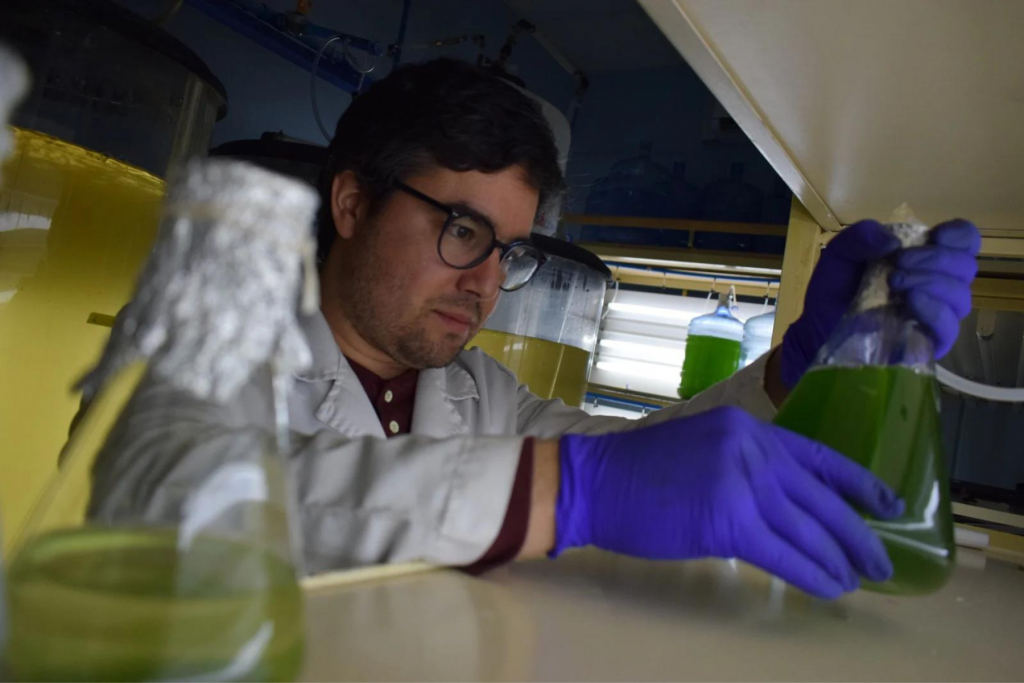
Project aims to generate a new alternative for obtaining healthy carotenoid compounds, which are extracted industrially from aquatic organisms such as micro and macroalgae.
The Doctor in Biological Sciences, Jorge Dagnino Leone and the Doctor in Natural Sciences Cristian Agurto Muñoz, belonging to the Interdisciplinary Marine Biotechnology Group (Gibmar) of the Center for Biotechnology of the University of Concepción, lead the project, titled «Healthy Carotenoid Bioreactors: A new alternative based on Metabolic Engineering in B. subtilis for the sustainable production of food ingredients. Project that seeks to scale a technology for the production of healthy carotenoids from environmental bacteria Bacillus subtilis, to be a new source of obtaining these molecules, which are currently obtained from microalgae such as Haematococcus lacustris, Dunaliella salina, Chlorella vulgaris and Phaeodactylum tricornutum.
According to Dr. Jorge Dagnino, this project arises from the results obtained in a FONDEF project from 2019 in which a strain was developed in B. subtilis, which was able to generate astaxanthin, a unique antioxidant that protects against oxidative damage and also has documented anti-inflammatory effects.
The relevance of natural astaxanthin production is due to its great antioxidant power, which makes it a very beneficial carotenoid for human health. It was during this project that we managed to generate strains of B. subtilis that could produce astaxanthin of identical characteristics to that produced Haematococcus lacustris (freshwater green algae), which is the only natural astaxanthin currently approved for consumption," he assured.
The proposal of this project also includes the participation of the Faculty of Pharmacy UdeC through the academics Dr Jessy Pavón Pérez, Dr Cristian Agurto Muñoz and Dr Cristian Rogel Castillo belonging to the Department of Food Science and Technology (CTyA), the academic Dr Claudia Mardones Peña from the Department of Instrumental Analysis (DAI) and Dr Carolina Gómez Gaete, academic from the Department of Pharmacy University of Concepción.
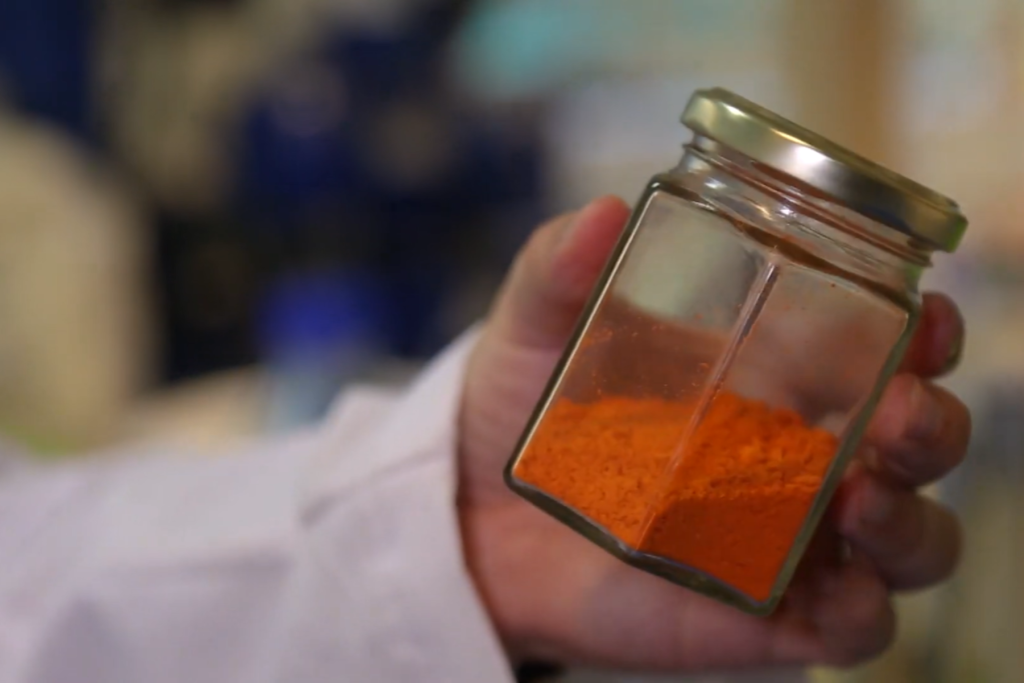
The project director, Dr. Dagnino, states that the expectations that the work team has regarding this project are, first, to scale up the cultivation of the astaxanthin-producing strain and secondly develop a formulation based on astaxanthin produced by B. subtilis which can be integrated into food formulas focused on enteral feeding, in order to take advantage of the properties of carotenoids such as astaxanthin.
For Dr. Cristian Agurto although this involves a challenge "The Interdisciplinary Group of Marine Biotechnology has stood out since its origins in working with micro and macroalgae, either for the development of nutraceutical products or for biomaterials, however, the present project bases its objective on working with environmental bacteria, which can be seen as a challenge for the development of this". However, it is not first “As a team we have faced various challenges, such as breaking the paradigm of just working with microalgae or only macroalgae, getting as a laboratory working with both groups of algae without problems. So, when the time came to address this new topic with bacteria it was difficult to address it because we are expressing algale compounds of high value with the measures of biosafety requirements for both types of organisms’.
Recognition and financing
Today the research has the award of an ANID-SIA Advanced Technologies project 2023 for the next 4 years. The proposal was selected from a total of 57 applications at the national level and from 7 applications from the University of Concepción. All this was complemented by the fact that the Biobío Region, in terms of the central-south macrozone ANID, awarded only two projects to the University of Concepción.
For the Director of the Biotechnology Center of the University of Concepción, Dr. Rosario Castillo, the award of this project marks a great milestone for the distribution. «The award and development of this project is a milestone for the Center of Biotechnology, not only because it constitutes a high-scale project in terms of the financing achieved, but because it allows to strengthen two important lines of work that the Center for Biotechnology is trying to boost,” he said.
Dr. Castillo added that, “on the one hand, the increase in technological maturity and scaling of processes developed in the Centre’s R & D projects, and on the other hand, the application of biotechnology in the generation of functional and sustainable food. Although historically the Centre has developed multiple projects related to the use of lignocellulosic resources, aquaculture and environmental biotechnology, today there are groups very powerful innovating in the area of functional foods, also obtained with more sustainable processes".
For his part, Dr. Jorge Dagnino says that the challenges that arise have the potential to come with a technological, commercial and also social impact. "Work with bacteria has some advantages compared to other biological models and this allows us to generate new ideas for future work in the laboratory. Fortunately, the guidelines of ANID-SIA are currently aimed at the development and maturity of applied technologies that allow impact on society,” he concluded.
Image credit: UdeC Biotechnology Center.