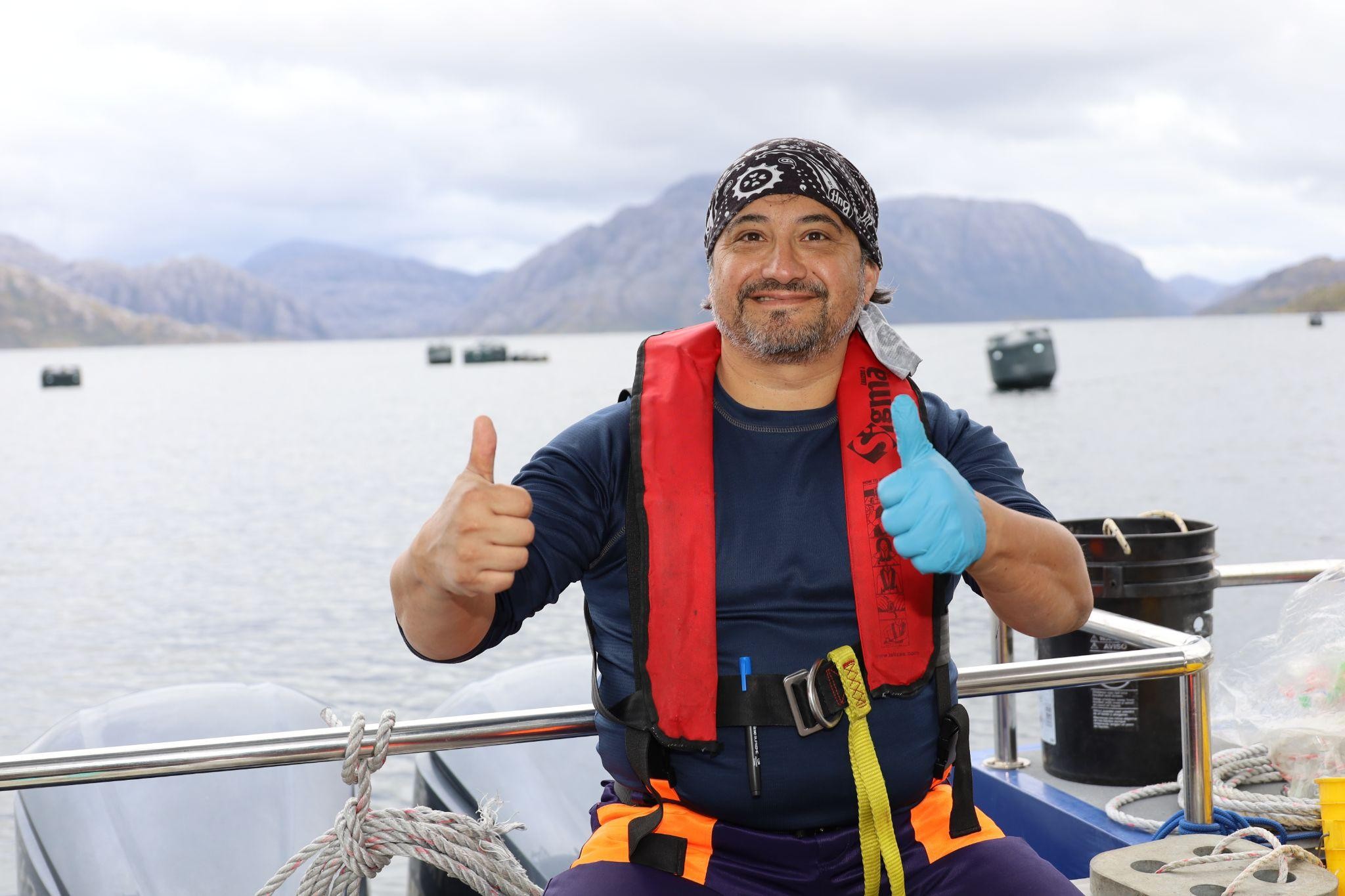
Study provides an integrated view of how bacteria change in marine sediments under salmon farming centers in southern Chile, using a graded scale of giant sulfur-oxidizing bacteria (GSOB).
A research that represents a paradigm shift in the assessment of marine bacteria (sulfur-oxidizing giant bacteria (GSOB), large microorganisms), would allow to identify environmental changes related to salmon farming and implement simpler and more transparent methods to care for ecosystems and regulate aquaculture in a more sustainable way, which was recently published in the journal Marine Pollution Bulletin, with the title «Shifts in prokaryotic communities and giant sulphur-oxidising bacteria in response to salmon farming in sub-Antarctic marine sediments.
In this context, the scientist leading the study is the Dr. Carlos Aranda, Associate Professor, Department of Biological Sciences and Biodiversity from the University of Los Lagos, who has developed this research on giant oxidizing sulfur bacteria for several years at the University of Los Lagos, including previous scientific publications in 2010, 2015 and 2021.
Its origin dates back to My incorporation into the university, when I started studying the possible presence of these bacteria in sediments affected by intensive salmon farming. At that time, it was a practically unexplored topic by the national scientific community, despite the important implications it already had for environmental management in the sector, stated.
Over time, added Dr. Aranda, the situation has changed significantly. Currently it is a widely recognized issue, and there is greater openness from companies to support research aimed at updating, modernizing and harmonizing the regulatory framework for aquaculture.
In this context, the research line has been strengthened thanks to the direct support of companies in the salmon farming sector, especially those grouped in Salmón Chile A.G. Particularly highlighted is the collaboration of Australis Mar S.A., which has provided resources and logistical support for the mentioned sampling, and of Intesal S.A., which has driven this line of work through its Science Plan specified.
Research
The researcher explained that the sediments under the cages were evaluated using a GSOB cover scale, ranging from minimal findings of these bacteria in the cavities surrounding the rocks to extensive and consolidated mats. By combining visual and molecular data, it was shown that bacterial diversity changes according to the impact of the activity and the extent of the mats. It was demonstrated that the visual method is even more sensitive than the molecular one, and a graduated scale system was introduced that can improve environmental monitoring compared to the traditional criterion of only presence or absence of GSOB.
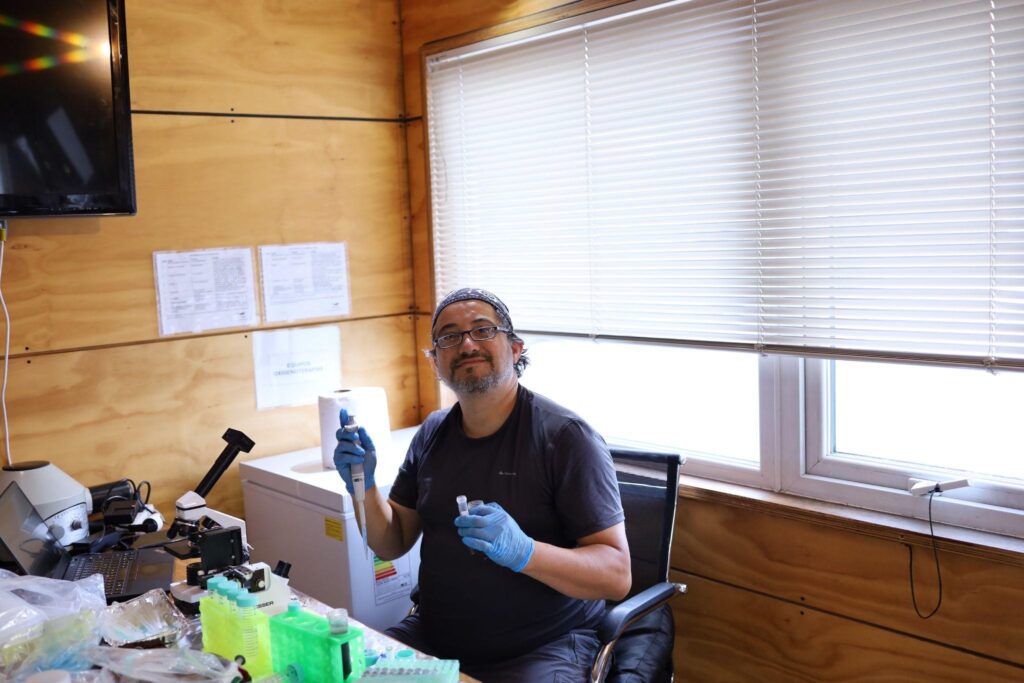
Explained in simple terms, he added, The study shows that recording the white bacterial patches on the seafloor using a coverage scale, and not just noting whether they are present or not, is a clear tool for identifying environmental changes related to salmon farming. This approach allows implementing simpler and more transparent methods to care for ecosystems and regulate aquaculture in a more sustainable way stated.
Process
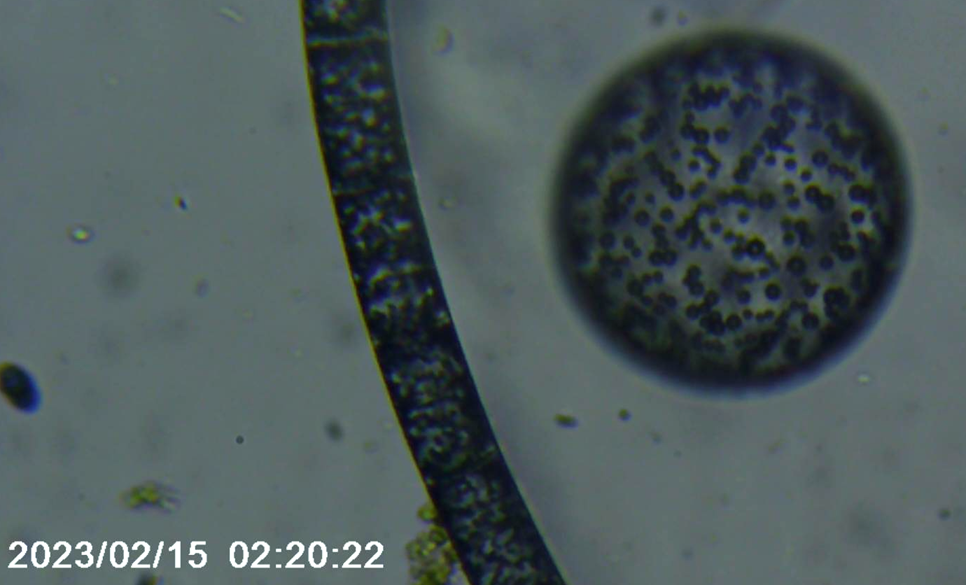
Dr. Carlos Aranda indicated that bacteria obtain energy from inorganic compounds, in contrast to organisms that consume organic matter. In particular, they use sulphurated hydrogen (H2S) that is released into sediments rich in organic matter when oxygen is no longer available, and other bacteria use sulphates to degrade organic matter, producing H2S as a product. “GSOBs sitting on the surface take advantage of sulfated hydrogen as a source of energy, allowing them to perform their vital functions and form extensive mantles visible on the seabed”, indicated.
During this process, he added, GSOB accumulate elemental sulfur granules as an intermediate step in H2S oxidation. “These granules act as mirrors that reflect light in all directions, making bacteria visible as bright white spots under lighting on the seabed rich in organic matter,” specified.
To detect and record their presence, submarine robots (ROVs) are used that travel the seabed, illuminate the area and record high definition videos that are subsequently reviewed by the authority, who uses these records to confirm the existence of GSOB and classify the seabed as anaerobic according to environmental regulations, preventing sowing in the next production cycle as long as the restoration is not demonstrated. of aerobic conditions, which in this case implies the absence of GSOB in any of its degrees.
Marine Pollution Bulletin scientific journal
As for the relevance of publishing in the Marine Pollution Bulletin, it is a magazine, indexed in WoS and with an impact level (currently 4.9), that is internationally recognized for its focus on marine pollution, rational use of estuarine, marine and ocean resources, and the development of methodologies to assess and compare the ecological status of aquatic ecosystems at the global level.
“Disseminating results in this medium guarantees international scientific visibility, credibility and rigor, and opens opportunities for findings to be considered by environmental managers, regulatory entities and the scientific community of different countries. In addition, it contributes to the development and improvement of evidence-based regulatory standards and facilitates the comparison between experiences and regional data, thus strengthening the impact real research in environmental protection and public policies”, highlighted.
Impact
The impact of this publication is relevant because it provides, for the first time, a comprehensive view of how bacteria in marine sediments change under salmon culture centers in southern Chile, using a graduated scale of coverage of giant sulfur oxidizing bacteria (GSOB). The study shows that this gradient is a more accurate visual indicator to detect environmental impacts than the traditional approach based on only in the presence or absence of GSOB according to the current regulation.
In addition, it is evident that only the presence of GSOB in its minimum degree (insulated vestiges around cavities in rocks), “does not necessarily involve a serious environmental problem, as in these cases there may not be any significant changes in the bacterial structure of the sediment”, cleared up.
Therefore, the publication, he added, “supports that the interpretation of GSOB as an indicator of environmental deterioration can be improved by using a graduated and calibrated visual inspection with molecular analysis. This allows for more objective, realistic and effective monitoring and management for Patagonian ecosystems linked to salmon aquaculture.” He emphasized.
Lagos
For Dr. Aranda, the relevance of this publication to ULagos and the Department of Biological Sciences and Biodiversity is considerable, “since it ranks the university as a benchmark in environmental research linked to aquaculture in Chilean Patagonia. This work reflects leadership in the development of advanced methodologies (such as DNA sequencing, mapping with ROVs and integrated ecological analysis) applied to the management of vulnerable marine ecosystems.” He pointed out.
The academic said that the Department's national and international scientific recognition is strengthened, demonstrating the capacity to generate results with a direct impact on the environmental regulations and the sustainable operation of the salmon industry.
Publishing in high-profile journals such as Marine Pollution Bulletin increases institutional and academic value, opens opportunities for new collaborations and encourages advanced training of students and researchers. “All this contributes actively to the fulfilment of the university mission of generating relevant knowledge and linked to the social and productive needs of southern Chile,” He argued.
The researcher expressed his gratitude to Dr. Alejandro Buschmann and all the co-authors of the work, including the companies DVS Technology and Codebreaker Bioscience that made this achievement possible. Also the logistic support that allows the field work, moreover, has emphasized that this line of research represents an advance not only scientific, “but also in the construction of collaborative bridges between academia, companies and regulatory bodies. The integrative approach adopted allows us to address the environmental challenges of aquaculture with greater rigour and transparency, promoting more sustainable and evidence-based practices.” He held.
This example, he added, can inspire new research aimed at protecting ecosystems and adapting regulation to current challenges, “strengthening the role of the regional scientific community as a key agent for environmental management and productive innovation in southern Chile”, stated.
Projection
Currently, the research continues and new results are available, thanks to the financing of the Fisheries and Aquaculture Research Fund (FIPA 2023-15) and the support of the companies mentioned above, together with Salmones Blumar S.A. and Cermaq Chile S.A., whose contributions will allow us to present soon high value findings for the sector.