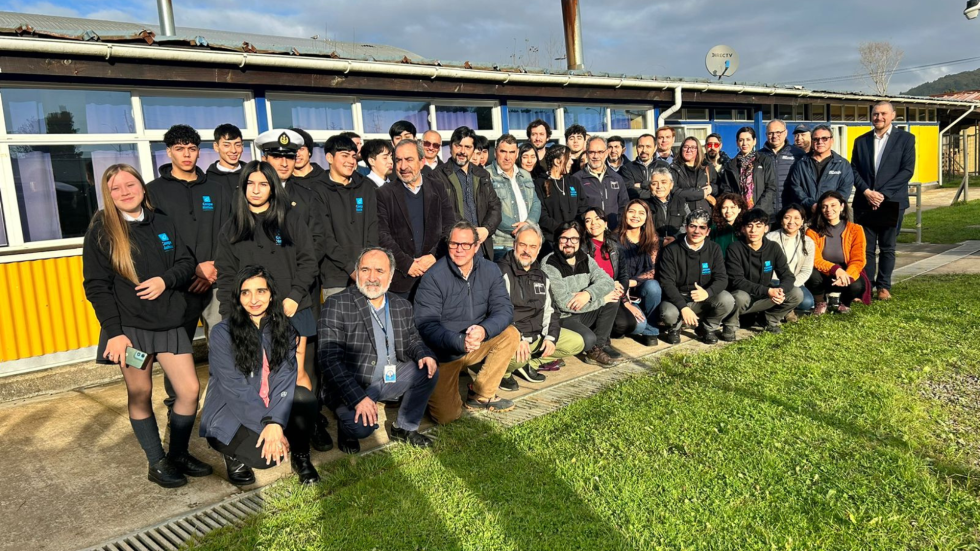
Through a collaboration agreement with the Sustainable Fisheries Center, the facility will become part of the demonstration experience for the conservation and restoration of the Huellelhue River estuary ecosystem. The initiative includes the production of seedlings in its hatchery.
With the Lingue River as the setting and the participation of local and regional authorities and environmental representatives, this Wednesday the signing of a Collaboration Agreement took place between the Mehuín Polytechnic Fishing School and the Sustainable Fishing Center, which will allow the development of a strategy for repopulation and ecosystem restoration of the Huellelhue estuary.
This agreement is within the framework of the GEF Incentives for Biodiversity Conservation (ICB) project, an initiative carried out by the Ministry of the Environment and the United Nations Development Programme (UNDP), with funding from the Global Environment Facility (GEF), which aims to implement economic instruments for conservation, among them, environmental good practice certifications. and mechanisms for payment for ecosystem services, which promote the commitment of local actors in the protection of nature.
"We are very happy because we really believe it is possible to align economic development with biodiversity conservation," said Victor Caro, Head of the Division of Information and Environmental Economics of the Ministry of the Environment and director of the GEF Incentives for Biodiversity Conservation project.
The agreement formalizes an alliance that has a deep value for the conservation of biodiversity, but also for the generation of local opportunities, through the educational model of the establishment.
"What we are going to do, specifically, is start a seed production process for choro zapato in the hatchery (or breeding facility) of the school, using breeders from the own Huellelhue river. This will allow us to develop repopulation activities in the natural bank of the cove, protecting the genetic integrity of this native species," said Miguel Espíndola, director of the Sustainable Fisheries Center.
To achieve this goal, the Mehuín Polytechnic Fishing School, which offers specializations in Aquaculture and Industrial Food Processing, puts its training and technical capacity at the service of the territory in the cultivation of this resource, thus strengthening the link between education and the environmental and economic well-being of Mehuín.
Robert Leiva, director of the Mehuín Fisheries Polytechnic School, said: "It is very important the milestone marked today, as communities from the Los Lagos Region and the Los Ríos Region will benefit, which are joining for a common good. In addition, this agreement helps us to have resources that will enable us to better train the professionals of tomorrow."
Finally, Miguel Espíndola highlighted that this agreement opens the door to new educational, technical and community capacities in favor of local impact conservation. "The alliance is good news for the economy of Caleta Huellelhue, because recovering this resource is also a bet to strengthen artisanal fishing with a long-term vision."